Priorities including housing, competitiveness, tech regulation, and more effectively including citizens in democratic decision-making among areas of joint work launched.
Priorities including housing, competitiveness, tech regulation, and more effectively including citizens in democratic decision-making among areas of joint work launched.
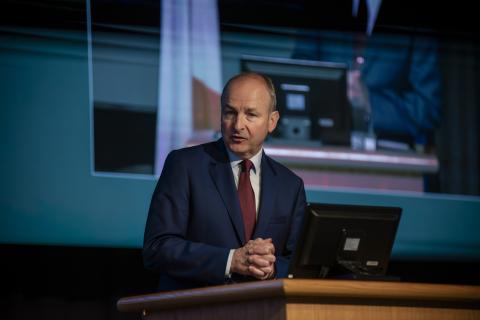
The European Economic and Social Committee (EESC), the EU body representing organised civil society, officially launched its cooperation with the Irish Government for the upcoming Irish Presidency of the Council of the European Union at a high-level event in Dublin Castle. The event brought together Taoiseach Micheál Martin TD, Minister of State for European Affairs Thomas Byrne TD and EESC President Séamus Boland.
The Irish Government has asked the EESC to contribute to several key presidency priorities, including housing, competitiveness, digital regulation, tackling poverty and the EU's approach to livestock policy. The aim is to ensure that the perspectives of civil society, employers and workers are reflected in EU policy-making. The presidency is particularly significant as it will coincide with the first Irish presidency of the EESC.
The Taoiseach highlighted the importance of dialogue between governments and society, stating: 'The ability of governments, employers, trade unions and organised civil society to engage constructively with one another is fundamental to democratic stability and to effective policy-making. The EESC is a vital link between civil society and the European institutions.'
He added: 'The voice of civil society matters. It matters because Europe cannot succeed through institutions alone. It succeeds when citizens feel ownership of the European project – when workers, farmers, entrepreneurs, voluntary organisations and local communities all feel that they have a stake in shaping Europe’s future.'
Minister Byrne underscored the role of citizen engagement in the presidency's priorities of competitiveness, security and values. 'Europe succeeds when people feel heard and represented. The work of the EESC remains central to that effort,' he said, adding that the Committee plays a valuable role in ensuring that a wide range of societal voices are heard in European decision-making.
EESC President Séamus Boland welcomed the shared agenda: 'I am very pleased that these areas of joint engagement – from democratic participation and equality, to competitiveness, small businesses, housing and digital fairness – reflect an EU Council Presidency that seeks to combine economic ambition with a strong social and citizen-centred dimension.' He added that the Committee particularly appreciates the emphasis on inclusive policy-making and democratic resilience.
As part of this cooperation, the EESC will prepare eight exploratory opinions for the Irish presidency covering democratic participation, equality and competitiveness, the EU livestock strategy, inter-generational poverty, simplification, the Single Market Strategy, the Digital Fairness Act and affordable housing construction. These opinions will support policy discussions and legislative work during the presidency.
The programme also included an exchange of views on the Irish presidency with Minister Byrne and a discussion on Maintaining Core Values in a New Europe, featuring representatives of business, trade unions, farming organisations, youth groups, environmental organisations and wider civil society.
In recent years, EU policy has been influenced by what some see as a selective reading of the Draghi and Letta reports on Europe's future. In a nutshell, the narrative is one of European decline vis à vis the United States, leading to a menacing productivity gap that entails a growing divide on GDP and, ultimately, wealth and growth. Only massive reforms and simplification can reverse this decline.
In recent years, EU policy has been influenced by what some see as a selective reading of the Draghi and Letta reports on Europe's future. In a nutshell, the narrative is one of European decline vis à vis the United States, leading to a menacing productivity gap that entails a growing divide on GDP and, ultimately, wealth and growth. Only massive reforms and simplification can reverse this decline.
By the EESC's Workers' Group
The relative waning of Europe's weight in the world is impossible to deny, given the development and growth of the rest of the planet. The train of thought from the productivity gap points, nevertheless, to the differences with the US.
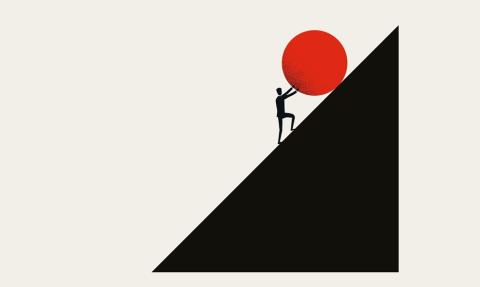
What if, however, there was no such thing as a growing divide? To begin with, the comparisons depend on indicators that are calculated with differing statistical methods, and to continue, they vary depending on the metric we choose. Productivity measured at current prices (year by year) has not declined in the EU compared to the US. Productivity measured at constant prices (one year as reference) has done so.
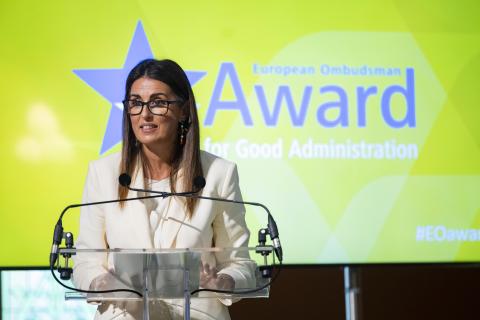
On 30 June, the European Economic and Social Committee initiative ‘Empowering youth voices through the EESC Youth Test’ joined three other finalists in the ‘Excellence in diversity and inclusion’ category at the ceremony for the Ombudsman Award for Good Administration. Amidst the shortlisted projects, the winning recognition was awarded to the DiscoverEU Inclusion Action, a European Commission initiative dedicated to opening Europe to young people with fewer opportunities.
On 30 June, the European Economic and Social Committee initiative ‘Empowering youth voices through the EESC Youth Test’ joined three other finalists in the‘ Excellence in diversity and inclusion’ category at the ceremony for the Ombudsman Award for Good Administration. Amidst the shortlisted projects, the winning recognition was awarded to the DiscoverEU Inclusion Action, a European Commission initiative dedicated to opening Europe to young people with fewer opportunities.
The EESC was represented at the ceremony by Vice-President Marija Hanževački, President of the EESC Youth Group Nicoletta Merlo and Secretary-General Isabelle Le Galo Flores. Emphasising the strategic importance of the nomination, Ms Hanževački underlined that youth participation in EU decision-making must become a necessity: ‘They are our present and future. We must remember: nothing about them, without them.’
Entries were drawn from 48 nominations and evaluated based on their demonstration of good public administration, a culture of service and a commitment to improving the lives of citizens. Following this review, three finalists were selected for each award category.
During the ceremony, European Ombudswoman Teresa Anjinho underscored the originality and innovation of the projects, stating: ‘This year’s nominations highlighted the quality of the work of the EU institutions with projects clearly driven by dedication and a strong commitment to public service and good administration.’
The EESC Youth Test enables youth organisations to shape the EESC’s agenda and opinions. The initiative was co-created with the European Youth Forum, and has made made the EESC the first EU institution to introduce a structured mechanism for involving young people directly in its core advisory work. At the heart of the Youth Test is a network of 73 youth organisations from across Europe and beyond. Every month, these organisations can express an interest in upcoming EESC opinions. Based on this input, the EESC section bureau select opinions to be ‘youth tested’. Youth representatives then participate in study group meetings, providing concrete contributions that feed directly into the opinion-drafting process.
Since its launch, over 80 EESC opinions have been youth tested. The initiative has also inspired institutional change, with the European Commission introducing its own Youth Check, and other administrations at EU, national, regional and local level looking to the EESC as a reference point for meaningful youth participation.