The European Economic and Social Committee (EESC) has warned that persons with disabilities across Europe continue to face segregation, inadequate services and barriers to legal capacity. It has called for binding EU legislation, stronger monitoring and better use of EU funds to make community‑based living a guaranteed right rather than an aspiration.
The European Economic and Social Committee (EESC) has warned that persons with disabilities across Europe continue to face segregation, inadequate services and barriers to legal capacity. It has called for binding EU legislation, stronger monitoring and better use of EU funds to make community‑based living a guaranteed right rather than an aspiration.
At its March 2026 plenary session, the EESC adopted an exploratory opinion on how to ensure social inclusion and independent living for persons with disabilities through high‑quality, specialised social services. In the opinion, the Committee sets out a clear roadmap to close the gap between commitments and reality, building on the UN Convention on the Rights of Persons with Disabilities (UNCRPD), the Strategy for the Rights of Persons with Disabilities 2021–2030, and years of civil‑society advocacy.
Grounded in Articles 12 and 19 of the UNCRPD, the Committee stresses that equal recognition before the law and the right to independent living are inseparable. Without full legal capacity, people cannot genuinely choose where and with whom they live. Despite ratification of the Convention by all Member States, many continue to rely on institutional models that limit autonomy and participation.
During the plenary debate, rapporteur Pietro Barbieri thanked the Cypriot presidency for requesting the EESC to draft the opinion, which had allowed the Committee to shed more light on this issue.
'Unfortunately, there is still a long way to go: data indicates growing segregation. To break this vicious cycle, we need binding measures, starting with the European Union funds, and the adoption of Article 12 of the CRPD, from safeguards to decision-making support, Mr Barbieri added.
Although independent living is a key priority of the EU Disability Strategy, the Committee highlights a persistent implementation gap. Institutionalisation remains widespread, while political inertia, limited accessible housing and inconsistent reforms slow progress. The opinion also warns against 'trans‑institutionalisation', where smaller settings reproduce institutional practices without restoring control or decision‑making.
A lack of reliable, harmonised data across the EU further hampers monitoring and accountability, allowing setbacks to remain hidden. The EESC calls for improved data collection with the involvement of disabled people's organisations (DPOs).
To address these shortcomings, the Committee urges EU funds to stop financing segregation, calls for mandatory national de‑institutionalisation strategies and stresses the need for a binding EU directive to give effect to Article 19 of the UNCRPD. Genuine inclusion, it concludes, requires accountability, partnership and a firm shift towards person‑centred, community‑based support that enables persons with disabilities to live with dignity, autonomy and full participation. (lm)
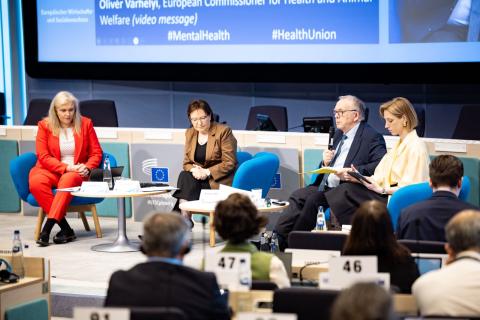
Emotional health is becoming one of the defining challenges for Europe’s next generation. Rising levels of anxiety, depression and suicide among young people reflect mounting pressures linked to social media, cyberbullying, loneliness, economic insecurity and the lasting effects of recent crises, it was highlighted at a high-level debate held by the European Economic and Social Committee (EESC) at its March plenary session.
Emotional health is becoming one of the defining challenges for Europe’s next generation. Rising levels of anxiety, depression and suicide among young people reflect mounting pressures linked to social media, cyberbullying, loneliness, economic insecurity and the lasting effects of recent crises, it was highlighted at a high-level debate held by the European Economic and Social Committee (EESC) at its March plenary session.
The emotional well-being of children and young people was in the focus of the three-part flagship debate that brought together EU institutions, international organisations, civil society and youth representatives. The discussions underlined the growing urgency of protecting emotional health through prevention, safer digital environments and stronger community-based support. While health policy remains a national competence, the EU plays an increasingly important role through prevention, digital regulation and cross-sector cooperation.
Opening the debate, EESC President Séamus Boland stressed the need to confront stigma and silence surrounding mental health: ‘For me, what is crucial is that this debate helps to bring the topic of emotional health and suicide out of the shadows; it is imperative that we destigmatise and demystify issues surrounding mental health. Communities, families and civil society organisations play a key role in those efforts.’
Discussions highlighted the scale of emotional distress across Europe, alongside significant inequalities in access to support. Long waiting times, limited child‑specific services and weak early‑intervention systems disproportionately affect vulnerable groups, including LGBTQI+ young people, migrant children and those in rural or low‑income communities. The World Health Organization and UNICEF have repeatedly warned that mental‑health conditions are rising fastest among young people.
Institutional speakers acknowledged growing awareness but uneven implementation across Member States. Calls focused on stronger prevention, improved digital literacy and child‑centred services, while recognising the links between emotional health, education, inclusion and culture. Cultural initiatives were highlighted as effective tools to strengthen resilience, alongside EU‑level actions such as the comprehensive mental‑health approach and new measures against cyberbullying.
Participants also addressed emerging digital risks, warning of escalating online harms, including deepfake abuse that overwhelmingly targets young women and girls. Several speakers cautioned against re‑institutionalisation, calling instead for community‑based, person‑centred care, early identification and school‑based support. Investment in psycho‑education, safer online environments and better regulation featured prominently.
In closing, the EESC called for closer cooperation between EU institutions, Member States and civil society. Emotional health spans education, social policy, labour markets and digital regulation, requiring coordinated and sustained action. Members reaffirmed that safeguarding the emotional well-being of Europe’s young people must remain a political priority. (lm)
This hearing will bring together representatives from EU institutions, organised civil society and voices from candidate countries to gather input for the EESC’s opinion on enlargement and climate.
Display date
2 months 2 weeks ago
The Role of the Private Sector and Civil Society in Strengthening Economic Cooperation within the Pact for the Mediterranean