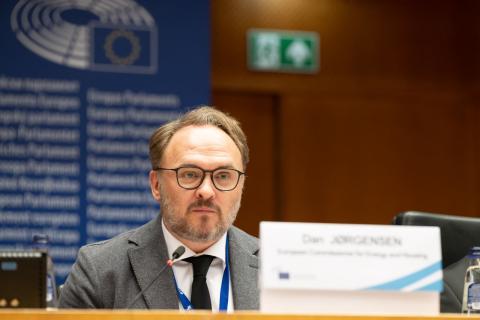
At its September plenary session, the European Economic and Social Committee (EESC) hosted a debate with the Commissioner for Energy and Housing, Dan Jørgensen, and called on the European Commission to take urgent action to address the ongoing housing crisis.
At its September plenary session, the European Economic and Social Committee (EESC) hosted a debate with the Commissioner for Energy and Housing, Dan Jørgensen, and called on the European Commission to take urgent action to address the ongoing housing crisis.
The EESC urged the Commission to draw up a European action plan on affordable housing. It has contributed a specific opinion on the subject and stands ready to organise the first ever EU housing summit together with the Commission, the European Parliament and the Committee of the Regions.
The outgoing EESC Vice-President for Communication, Laurenţiu Plosceanu, emphasised the Committee’s commitment to decent, affordable, sustainable housing for all, underscoring the contribution made by civil society to the upcoming European Affordable Housing Plan. 'Our message is clear: the EU needs an action plan to make the right to housing a reality and to anchor it in EU law,' he said.
Commissioner Jørgensen acknowledged the scale of the challenge, noting that many Europeans struggle to find affordable, dignified housing. He stressed that addressing the crisis is an opportunity to make a lasting difference: 'If we want a Europe that is fairer, more competitive and truly independent, we need housing that is decent, sustainable and affordable for every citizen.'
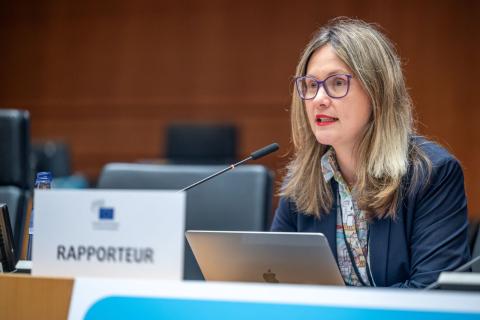
The EESC’s newly adopted opinion, drafted by John Comer and Thomas Kattnig, calls for the right to decent, sustainable, affordable housing to be formally enshrined in EU primary law.
‘Sustainability goes hand in hand with affordability. People cannot afford houses. A lot of Europeans living in cities are paying up to 40% of their salary for housing,’ said Mr Comer.
'The housing crisis goes right to the centre of society and can do a lot of damage to democracy,' said Mr Kattnig.
The EESC calls for a coordinated EU approach that respects subsidiarity, as housing policy remains primarily a Member State competence. It also calls for reforms to state aid rules to broaden access to social housing, noting that current definitions exclude middle-income households and key workers.
The EESC recommends coordinated action to regulate short-term rentals, including transparent data exchange, targeted local measures and strict oversight to prevent speculative investment and tax evasion. Civil society voices in the debate stressed the importance of sound fiscal policies, tailored solutions for different housing systems and innovative EU financing to support retrofitting and social housing. (mp)
At its September plenary, the EESC adopted an opinion urging the European Commission to ensure that the Citizens’ Energy Package truly puts people at the heart of the EU’s energy system.
At its September plenary, the European Economic and Social Committee (EESC) adopted an opinion urging the European Commission to ensure that the Citizens’ Energy Package truly puts people at the heart of the EU’s energy system. The EESC emphasises that the initiative must go beyond a checklist and become the foundation of a genuine social pact for a citizen-driven energy transition.
The Committee calls for clarity on key concepts such as energy communities and prosumerism, advocating a shift from viewing people as passive consumers to active co-creators of Europe’s energy future. In the opinion drafted by Corina Murafa Benga, the EESC proposes concrete measures, including regulatory sandboxes, dedicated funding streams and technical support to make energy communities and energy sharing a functional reality across the EU.
‘Current EU energy discourse frequently positions individuals as “consumers”, implicitly reinforcing market-centric models. We need a shift towards viewing people as “citizens” – members of a political community with energy rights,’ said Ms Murafa Benga. ‘There can be no citizenship without energy, and the EU must uphold the full implementation of European citizenship.’
Energy communities are highlighted as strategic actors in the transition, and the EESC urges the Commission to provide clear guidance on their establishment and operation, tax and tariff deductions, and support from distribution system operators (DSOs). The Committee also recommends that the European Investment Bank develop a facility for local and regional energy communities, and that funding prioritise youth engagement, energy literacy and green skills.
Addressing energy poverty is a key priority. The EESC calls for a unified definition and data-driven identification of affected households, starting at the local level, and insists that households be the reference point for energy poverty milestones. The Committee urges the EU to adopt specific measures, such as an EU-wide ban on household disconnections, moving away from the merit order system that links electricity prices to gas prices, and establishing a European energy ombudsman with local branches.
The EESC also stresses the importance of linking public funding for energy projects to the participation of local communities as shareholders, and other forms of benefit-sharing. (mp)
The EESC has called for urgent action to ensure that artificial intelligence (AI) and Big Data are used ethically and inclusively in rare disease diagnosis and treatment. At its September 2025 plenary, the Committee adopted an opinion highlighting the need for digital innovation to improve patient outcomes while safeguarding rights and transparency.
The EESC has called for urgent action to ensure that artificial intelligence (AI) and Big Data are used ethically and inclusively in rare disease diagnosis and treatment. At its September 2025 plenary, the Committee adopted an opinion highlighting the need for digital innovation to improve patient outcomes while safeguarding rights and transparency.
With over 7 000 rare diseases affecting 300 million people globally, including 30 million in the EU, AI-driven tools can accelerate diagnosis and enable personalised treatments. However, the EESC warns that these advances must be balanced with robust ethical and legal safeguards. The Committee urges all EU Member States to digitise health data, adopt high-quality registration standards, and ensure that AI healthcare models only access anonymised, encrypted patient data.
Persistent gender and ethnic disparities in rare disease diagnosis must be addressed. The EESC calls for gender-diverse training data, bias audits, and targeted funding to increase female participation in AI healthcare. Patients should have control over their health data, with ongoing consent and transparency about data use.
To prevent market dominance, the EU should support start-ups and SMEs developing AI for rare disease diagnostics. Public-private partnerships and fair data access are vital to keep innovations affordable and accessible. The EESC demands EU-wide ethical guidelines, physician oversight, and professional training to empower healthcare workers and patients. (lm)
The negotiations on the EU 2040 climate target are deadlocked. The European Economic and Social Committee (EESC) is backing the proposed Climate Law Amendment and warning that the target must also reflect the EU’s likely future expansion.
In an opinion adopted at its September plenary, the EESC urged the Council and Parliament to seal the 90% target before COP30 in Brazil, warning that Europe risks losing credibility if it drags its feet.
Teppo Säkkinen, rapporteur for the opinion, said: 'As the fastest warming continent, decisive global climate action is in Europe’s own interest. If we want China, India and others to raise their ambition, we must show that we are serious ourselves.'
EU enlargement should be factored into the climate target, as by 2040 the EU is likely to have new members. The reconstruction of Ukraine could help achieve these goals, Mr Säkkinen said. 'Supporting climate action in Ukraine, Moldova and the Western Balkans will ease their path to EU membership and directly contribute to EU climate targets.'
The EESC recommends going beyond the Commission’s draft to include international credits from candidate countries starting in 2031. Other proposed amendments include:
Ensuring the high quality of international credits: Any credits must be of high integrity, and should be excluded from use in the EU Emissions Trading System (ETS). Reducing emissions in the EU should be the main priority of climate action.
Exporting clean technologies: Adding exports of clean technologies to the law’s economic objectives and establishing a Clean Industrial Scoreboard to track jobs, innovation and Europe’s place in the global green economy.
Food security and energy poverty: Inserting explicit requirements into the Climate Law to safeguard food production and reduce energy poverty to sustain rural communities and bring down power and heating bills for homes.
The Committee calls for broad stakeholder dialogue to shape the policies supporting the 2040 target: 'The transition must be grounded in real action to keep everyone on board from entrepreneurs to workers, farmers and families, or it won’t succeed.'
Beyond climate goals, the opinion links decarbonisation to defence, urging investment in dual-use innovations like decentralised clean power for military logistics and low-carbon materials for equipment and construction. Reducing fossil fuel dependency is also a matter of European security.
The opinion also applied the Youth Test, keeping the next generation central to Europe’s climate strategy, as climate action will shape young Europeans’ future quality of life. (ks/fb)
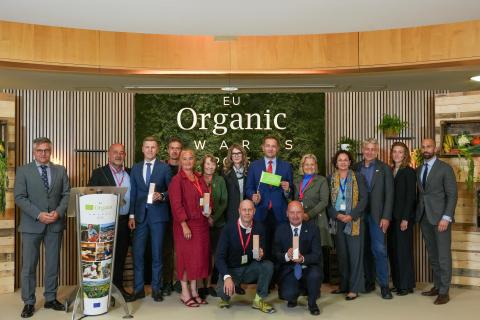
During EU Organic Day on 23 September, the EESC welcomed the winners of the fourth EU Organic Awards in three key categories: Best organic food processing SME, Best organic food retailer, and Best organic restaurant/food service.
During EU Organic Day on 23 September, the EESC welcomed the winners of the fourth EU Organic Awards in three key categories: Best organic food processing SME, Best organic food retailer, and Best organic restaurant/food service.
• Best organic food processing SME is Joseph Brotmanufaktur GmbH (Austria). Working with 24 smallholder families on 14 rare grain varieties, it preserves grain culture and promotes biodiversity, fair value chains, and sustainable food systems.
• Best organic restaurant/food caterer is Peskesi (Greece). Based in Heraklion, Crete, it runs its own organic farm and partners with 98% local producers under a 'Farm to Table' and 'Table to Farm' philosophy since 2014.
• Best organic food retailer is Radis&Bona eG (Germany), a Regensburg cooperative farm shop offering 100% organic products from within 80km since 2021. Its cooperative model strengthens regional farming, ensures fair prices, and promotes sustainability through short supply chains and community participation.
Over 100 applications from 13 countries were received, with 21 shortlisted. The EU Organic Awards feature six categories and seven awards recognising innovative, sustainable, and inspiring organic projects.
The remaining three categories are best organic city, region and farmer, where the winners are recognised by the European Committee of the Regions, COPA-COGECA, and IFOAM Organics Europe who organise the EU Organic Awards together with the European Commission and the EESC, with support from the European Parliament and the Council.
EESC member Stoyan Tchoukanov said: 'From large-scale organic bakeries to regional organic cooperative shops and farm restaurants, this year's winners again showcased excellent and innovative organic businesses in the EU. But in order to reach the 25% target by 2030, we need to step up further the consumption of organic products and integrate organic farming and other quality schemes into environmental, health, climate and rural development strategies.'
EU Organic Day, launched in 2021 by the European Parliament, the Council and the Commission, promotes organic farming. The EU supports the sector through EU Organic Day, the EU Organic Awards and EUR 14.7 billion via CAP Strategic Plans (2023-2027) to help farmers convert and maintain organic production. There are now 30% more organic farmers than in 2018, almost all Member States have organic strategies, and the EU is the world’s second-largest organic market. More actions in this factsheet (ks/fb)
Proposal for a REGULATION OF THE EUROPEAN PARLIAMENT AND OF THE COUNCIL establishing the European Fund for Regional Development including for European Territorial Cooperation (Interreg) and the Cohesion Fund as part of the Fund set out in Regulation (EU)…
Proposal for a REGULATION OF THE EUROPEAN PARLIAMENT AND OF THE COUNCIL establishing the European Fund for Regional Development including for European Territorial Cooperation (Interreg) and the Cohesion Fund as part of the Fund set out in Regulation (EU)…