
European Economic
and Social Committee
Speech by Vice-President Pietro Barbieri, EESC plenary debate with Michael McGrath, European Commissioner for Democracy, Justice, the Rule of Law and Consumer Protection
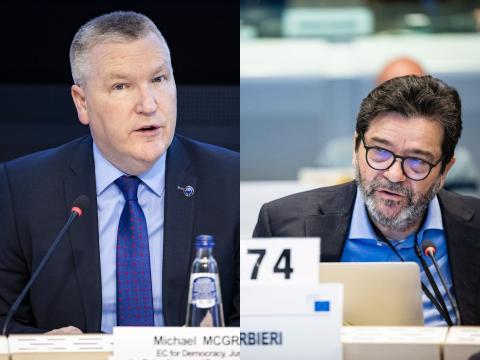
EESC plenary debate on: De-polarising societies – Key take-aways of the Civil Society Week 2025
Dear Commissioner McGrath, Esteemed Speakers, it is a pleasure to have you with us at our plenary.
I will speak today on behalf of Séamus Boland, president of the Civil Society Organisations' Group, who can unfortunately not attend today.
First, let me congratulate you, President Röpke and all the services involved, for two successful events: the Civil Society Week and the Your Europe, Your Say. These flagship events are examples of dialogue and cooperation with civil society organisations and citizens.
I would like to echo the recommendations that we heard today from Brikena Xhomaqi. We need to Build a Strong European Strategy for Civil Society.
Civil society is the oil in the engine of our societies. Civil society organisations act as local safety nets. At the same time, they are key enablers of democracy and fundamental rights.
It is therefore with great interest that we noted the announcement of a Strategy to support, protect and empower civil society and to set up a Civil Society Platform.
In coordination with my Group's president, Séamus Boland, I will focus my remarks on two points: civil dialogue should be built on existing structures and bring together all relevant stakeholders.
Firstly, when setting up a Civil Society Platform, we do not have to start from a greenfield site. The EESC must be involved from the outset.
Let me give you only two examples of our work:
1) More than 20 years ago, the EESC set up its Liaison Group, a unique institutionalised structure for dialogue with European networks. At the same time, the EESC is a direct channel to national civil society.
I believe that there is also some untapped potential in this house. For instance, each year, the EESC could facilitate a wide dialogue process, which would feed into the EESC's contribution to the annual work programme of the European Commission.
2) If we are to reinforce civil dialogue, we need to have an overview of what is already happening. This is why our Group has initiated a mapping exercise of civil dialogue. Our hope is that this study can directly support the work of the European Commission.
Moreover, in the latest Opinion of this house, for which I was rapporteur, the EESC calls for a strategy for civil dialogue, potentially resulting in an interinstitutional agreement. This leads me to my second point: Progress on this strategy and a potential interinstitutional agreement needs to be the result of a shared process.
That is why my Group has called for a working group to be set up, to be facilitated by the EESC, and involve all relevant stakeholders, CSOs and EU institutions.
We heard last week that consultations on the Civil Society Strategy and Platform will start shortly. I will therefore end on a call to the European Commission: now is the ideal time to consult and involve, to make time and space for dialogue that is needed. The EESC is the ideal place for this.
Thank you for your attention.
Work organisation
Downloads
-
Speech by Vice-President Pietro Barbieri