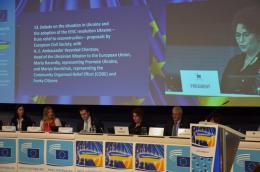
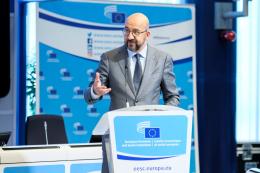
The European Economic and Social Committee (EESC), just a week ahead of the EU Council Summit, adopted its second Resolution on Ukraine, strongly supporting the country's unconditional candidate status to the EU. The European civil society will be working hand in hand with Ukraine for Ukraine on the reconstruction of the country delivering a stronger, greener, more resilient and sustainable European partner.
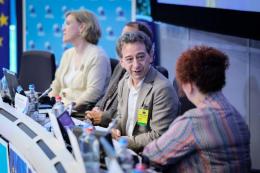
With the Declaration of Digital Rights and Principles and the Data Act, the EU is taking two more steps towards the creation of a digital space that puts people at its centre, a debate at the EESC's June plenary highlighted.
Key industrial sectors in Europe made the case for a more data-driven and future-oriented response to overcome the disruption arising from Covid, Russian aggression, the energy and climate crises, and industrial and social transformation.
A resilient, sustainable and inclusive Europe is only possible if organised civil society is systematically involved in both national recovery plans and the Commission's new REPowerEU strategy. During its annual conference in June, the European Semester Group (ESG) renewed its call for a regulation or directive to ensure civil society participation, and proposed a permanent and common investment financing mechanism to enhance crisis preparedness and response capacity.
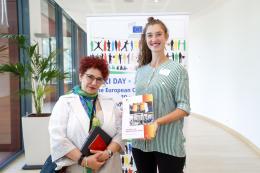
On European Citizens' Initiative (ECI) Day 2022, hosted by the EESC on 2 June, speakers and activists stressed that a more impactful ECI would also be more popular.
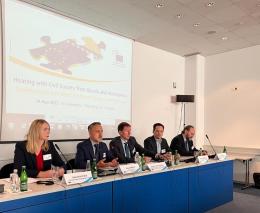
On 24 May in Sarajevo, the EESC's Western Balkans Follow-up Committee held its yearly external meeting - for the first time since the COVID-19 pandemic - to meet with civil society organisations (CSOs) in Bosnia and Herzegovina and discuss their role and concerns regarding the current situation. The conclusions will be conveyed to the country's political authorities and to the EU institutions.
The European Economic and Social Committee is calling on the European Commission to carry out more targeted impact assessments of its proposals for new EU budget funding sources to repay NextGenerationEU debt. The EESC generally agrees with the proposed EU "own resources" revenues for the budget. However, they need to be stable and fair – and should not burden households or businesses.
The EU's full range of competition policy tools - merger, antitrust and State aid control rules - and even its most basic concepts, such as market share, relevant markets and level-playing field, should be overhauled to serve the Union's climate and digital ambitions and the goal of resilience, which will require massive investment. Two new EESC opinions explain how this overhaul should be done.
The May plenary session of the European Economic and Social Committee (EESC) hosted a debate led by its President Christa Schweng and the President of the European Council Charles Michel on Europe's response to this turning point in history.