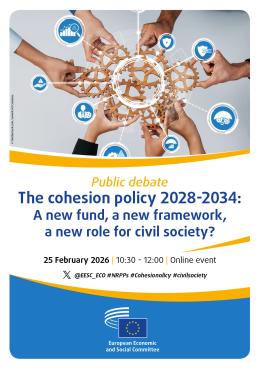
"Cohesion policy 2028–2034: A new fund, a new framework, a new role for civil society?" brings together EU institutions, social partners and civil society representatives to reflect on the future of cohesion policy in the next Multiannual Financial Framework. The hearing explores proposals for reforming cohesion funding and governance, assesses the implications of the new framework through the National and Regional Partnership Plans and examines how civil society organisations can play a stronger role in the design, implementation and monitoring of cohesion policy. The discussion aims to identify how cohesion policy can continue to deliver territorial, social and economic cohesion while responding to new challenges and transitions facing the European Union.
Public debate in the ECO Section on the Latest twists and turns on the road to the next Multiannual Financial Framework in the framework of the opinion ECO/682 Multiannual financial framework 2028-2034.
The public hearing will examine how national, local and civil society actors will work together to foster collaboration through partnership principle and multi-level governance in order to deliver more inclusive, sustainable, and resilient outcomes across all regions.
At the initiative of the EESC’s Civil Society Organisations’ Group, this exhibition showcased projects that have been coordinated by the Danish architecture firm BIG-Bjarke Ingels Group.
An initiative of the Civil Society Organisations’ Group in cooperation with Friends of the Earth Europe
-
Location
EESC headquarters, JDE building, Rue Belliard/Belliardstraat 99-101
Brussels
Belgium
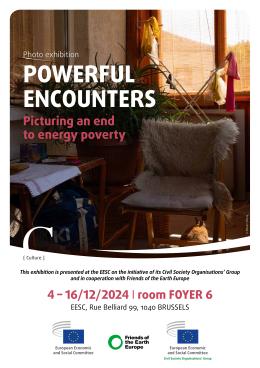
The European Economic and Social Committee (EESC) presented the photo exhibition ‘Powerful Encounters: Picturing an end to energy poverty’ on the initiative of its Civil Society Organisations’ Group and in cooperation with Friends of the Earth Europe. The work of photographer Miriam Strong was exhibited from 4 to 16 December 2024 at the EESC’s premises in Brussels.
Una exposición organizada por el Grupo de Organizaciones de la Sociedad Civil del CESE en el contexto de su conferencia «Soberanía alimentaria europea: el papel de la agricultura, la pesca y los consumidores»
-
Location
Edificio CINC, Cidade da Cultura de Galicia, Monte Gaiás
A Sustainable Recovery for the Future of Europe's Citizens
-
Location
Brussels
Belgium
Following the outbreak of the COVID-19 pandemic, 2020 has proved to be an endurance test for human and social rights, democratic values, the rule of law and economic resilience in the EU. While navigating stormy waters, organised civil society is playing a key role in coping with the countless pandemic-related challenges at European, national, regional and local level.
Europe is facing a pivotal moment. Social and economic inequalities, rapid technological change, anti-democratic forces and geopolitical instability are straining the foundations of the European project.
With democracy and civic space under mounting pressure, civil society organisations, human rights defenders and free media face growing constraints - from restrictive laws and disinformation campaigns to underfunding and public distrust. Deepening polarisation and eroding trust in institutions further undermine Europe’s democratic model.