European Economic
and Social Committee
European Economic
and Social Committee
The European Economic and Social Committee (EESC) is the voice of organised civil society in Europe.
Find out more about its role and structure at http://www.eesc.europa.eu/en/about
The EESC issues between 160 and 190 opinions, evaluation and information reports a year.
It also organises several annual initiatives and events with a focus on civil society and citizens’ participation such as the Civil Society Prize, the Civil Society Days, the Your Europe, Your Say youth plenary and the ECI Day.
Find the latest EESC opinions and publications at http://www.eesc.europa.eu/en/our-work/opinions-information-reports/opinions and http://www.eesc.europa.eu/en/our-work/publications-other-work/publications respectively.
The EESC is active in a wide range of areas, from social affairs to economy, energy and sustainability.
Learn more about our policy areas and policy highlights at http://www.eesc.europa.eu/en/policies
The EESC holds nine plenary sessions per year. It also organises many conferences, public hearings and high-level debates related to its work.
Find out more about our upcoming events at http://www.eesc.europa.eu/en/agenda/our-events/upcoming-events
Here you can find news and information about the EESC'swork, including its social media accounts, the EESC Info newsletter, photo galleries and videos.
Read the latest EESC news http://www.eesc.europa.eu/en/news-media/news and press releases http://www.eesc.europa.eu/en/news-media/press-releases
The EESC brings together representatives from all areas of organised civil society, who give their independent advice on EU policies and legislation. The EESC's326 Members are organised into three groups: Employers, Workers and Various Interests.
Find out more about our Members and groups at http://www.eesc.europa.eu/en/members-groups
The EESC has six sections, specialising in concrete topics of relevance to the citizens of the European Union, ranging from social to economic affairs, energy, environment, external relations or the internal market.
Find out more at http://www.eesc.europa.eu/en/sections-other-bodies
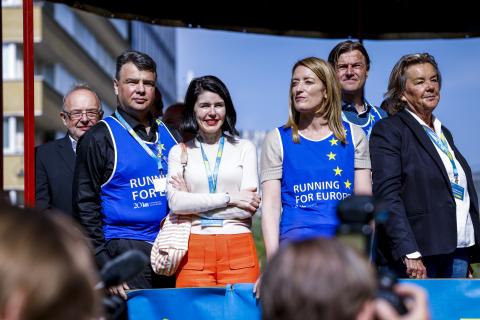
El domingo 28 de mayo de 2023, el Comité se unió a las demás instituciones de la UE que corren por causas benéficas en uno de los acontecimientos deportivos más conocidos de la capital belga, que celebraba su 43.ª edición.
Este acontecimiento –mediante el cual se festejó el deporte de base– reunió a más de cuarenta mil corredores y aficionados a la marcha originarios de ochenta y nueve países.
El equipo de la UE recaudó fondos para Amnistía Internacional, organización defensora de los derechos humanos.
Laurenţiu Plosceanu, vicepresidente de Comunicación del CESE, dio la salida al cuarto bloque de la carrera, junto con Roberta Metsola, presidenta del Parlamento Europeo, y Stefaan De Rynck, representante de la Comisión Europea.
El Sr. Plosceanu subrayó la dinámica presencia de las instituciones de la UE en el acto en defensa de la democracia y los derechos humanos, y describió a la multitud como «un tsunami de cuarenta mil ciudadanos corriendo por la paz, la democracia, los derechos humanos y los valores de la UE».
La asociación de becarios del CESE, compuesta por sesenta personas, participó en la carrera para recaudar fondos destinados a los veteranos de la guerra de Ucrania, en colaboración con la ONG Promote Ukraine y el Consejo Nacional de Rehabilitación Deportiva. Los fondos se destinarán a financiar programas de rehabilitación.
El acto fue organizado por el Syndicat d'Initiative - Bruxelles Promotion 1886 y contó con la participación del primer ministro belga, Alexander De Croo, que corrió por la Cruz Roja belga. (at)