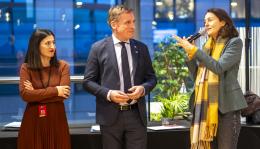
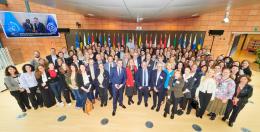
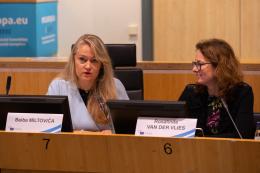
On the occasion of the 20th anniversary of the EESC's Liaison Group, the founders and current members of the Group called for intensive action to defend European democracy, open public space and a just Europe.
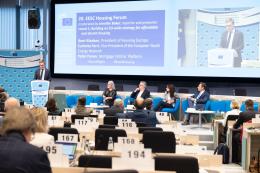
En su pleno de diciembre el Comité Económico y Social Europeo (CESE) celebró su primer Foro de la Vivienda, en el que subrayó la urgente necesidad de vivienda digna, sostenible y asequible en toda la Unión Europea. El Foro reunió a partes interesadas de alto nivel para abordar la actual crisis de la vivienda y explorar posibles soluciones.
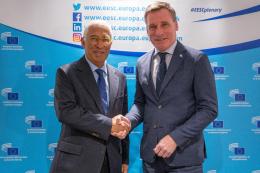
António Costa, the new President of the European Council, used his first appearance at the European Economic and Social Committee (EESC) to share his key priorities for the EU. He highlighted competitiveness as the basis for Europe’s future prosperity and reiterated his commitment to combining competitiveness with social rights to secure a sustainable future for Europe. In line with this, EESC President Röpke highlighted that the EU needs to strive for a competitiveness works for the many, not the few.
La conferencia de alto nivel del CESE celebrada en Budapest (Hungría) se tradujo en un firme llamamiento a la nueva Comisión Europea y a los Estados miembros de la UE para que elaboren un marco político global que establezca objetivos comunes y mensurables para abordar el protocolo de asistencia de las enfermedades raras y seguir aumentando la cooperación a escala de la UE.
The 9th European Migration Forum, organised by the European Economic and Social Committee (EESC) and the European Commission’s Directorate-General for Migration and Home Affairs, focuses on how civil society can play a key role in the forthcoming implementation of the Pact on Migration and Asylum, while highlighting the direct work of civil society organisations on the ground.
The next Commission must be the enlargement Commission. It is not a question of whether or not to enlarge, but rather how to do it right. This was the focus of the Enlargement High-Level Forum held by the European Economic and Social Committee (EESC) and attended by EESC President Oliver Röpke, European Commissioner for Jobs and Social Rights Nicolas Schmit and ministers from EU Member States and Enlargement candidate countries alike.
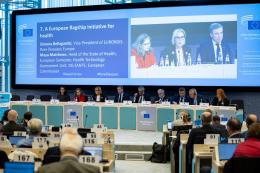
The European Economic and Social Committee (EESC) calls for a European flagship initiative for health, aiming to build a cross-cutting health architecture within the European Union. It also calls on the European Commission to publish an Action Plan on Rare Diseases with clearly achievable targets.
Journalists are under increasing pressure from governments and private interests that curb media freedom. On top of more familiar obstacles, they are now battling the challenges of generative AI, which, despite the many benefits it could bring, threatens to undermine the economic foundations of the profession.
El Comité Económico y Social Europeo (CESE) y la Comisión Europea han organizado una conferencia sobre la gestión de residuos radiactivos en la que se ha puesto de relieve la importancia de tener en cuenta la perspectiva de la sociedad civil organizada, además de evaluar pormenorizadamente los últimos avances científicos.
Civil society organisations, individuals and private companies can now enter their non-profit projects for the EESC’s prize dedicated to combating the harmful polarisation of European society