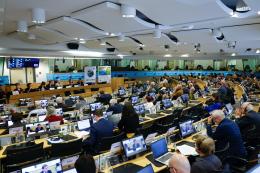
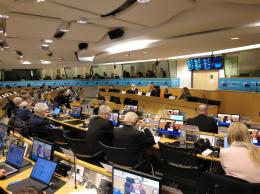
In a recent public hearing, the European Economic and Social Committee (EESC) examined the European Commission’s Defence of Democracy Package aimed at increasing the transparency of interest representation, reinforcing the resilience of elections and improving civil and civic participation. Representatives of civil society supported the overall spirit of the proposal but raised concerns about the narrow focus of the Directive on foreign influence and its potential repercussions on civic space in Europe.
La cartera de Prospectiva ha permitido a la Comisión Europea estrechar lazos con las organizaciones de la sociedad civil, lo que ha facilitado la incorporación de sus puntos de vista y ha convertido la planificación de las futuras políticas de la UE en un auténtico instrumento participativo.
While deploring all acts of violence, the European Economic and Social Committee's (EESC) NAT Section, which deals with agriculture, rural development and the environment, expresses solidarity with and support for farmers, who have seen their incomes reduced and livelihoods undermined following decades where farmers' views have not been taken into consideration, where decision-making processes (at EU level and in trade agreements negotiations) have not involved them and where the budget made available has not been aligned with sustainability objectives.
The European Economic and Social Committee's (EESC) call for an EU Blue Deal is garnering support from policymakers and civil society. This momentum is driven by a growing recognition of the urgency of addressing water scarcity and the potential of the Blue Deal to provide a comprehensive solution to this pressing issue.
To bolster small business growth in the EU, the European Economic and Social Committee (EESC) backs the Commission's Head Office Tax (HOT) system proposal. In its advisory opinion, the EESC advocates additional measures and emphasises the need for stronger collaboration among the Commission, Member States and representatives of micro, small and medium-sized enterprises (MSMEs) for effective implementation and awareness.
The European Economic and Social Committee (EESC) aims to lay the groundwork for a post-2027 common agricultural policy (CAP) that is resilient and sustainable and meets the needs of both farmers and society. The Belgian Presidency of the Council of the EU has tasked the EESC with formulating an opinion on how to achieve strategic autonomy and sustainable food production.The opinion adopted at its January plenary session.
In an opinion adopted at its January plenary session, the European Economic and Social Committee (EESC) addressed the impact of climate change and environmental degradation on peace, security and defence. The Committee stresses the urgent need to invest in setting up resilient responses to these global challenges. The Committee's position is that it is imperative to continue integrating the climate and security nexus by creating proactive interfaces between the institutions responsible for both external relations and the Member States' security and defence services.
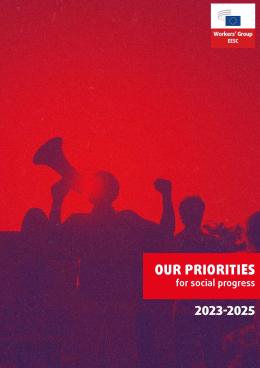
The document highlights the Worker's Group priorities for 2023-2025. We want to shape a social and sustainable future that also upholds the principles of the rule of law, human rights, gender equality, solidarity and diversity. We strive to empower our democracy, society, and everyone in it. Our journey is an ongoing commitment, demanding unwavering determination as we strive to shape a society marked by shared prosperity and equality.
Un debate organizado por el Comité Económico y Social Europeo (CESE) ha puesto de manifiesto que, a pesar de las últimas iniciativas, la presencia de hombres aún predomina en la ciencia, la tecnología, la ingeniería y las matemáticas. La UE debe adoptar nuevas medidas específicas para promover la participación de las mujeres y garantizar así una transición ecológica y digital justa.
In a recently adopted opinion, the European Economic and Social Committee (EESC) warns that the EU's overreliance on imports of active pharmaceutical ingredients and finished medicines from Asia poses threats to the health and well-being of EU citizens. The EESC therefore proposes a Critical Medicines Act.