
European Economic
and Social Committee
European Economic
and Social Committee
The European Economic and Social Committee (EESC) is the voice of organised civil society in Europe.
Find out more about its role and structure at http://www.eesc.europa.eu/en/about
The EESC issues between 160 and 190 opinions, evaluation and information reports a year.
It also organises several annual initiatives and events with a focus on civil society and citizens’ participation such as the Civil Society Prize, the Civil Society Days, the Your Europe, Your Say youth plenary and the ECI Day.
Find the latest EESC opinions and publications at http://www.eesc.europa.eu/en/our-work/opinions-information-reports/opinions and http://www.eesc.europa.eu/en/our-work/publications-other-work/publications respectively.
The EESC is active in a wide range of areas, from social affairs to economy, energy and sustainability.
Learn more about our policy areas and policy highlights at http://www.eesc.europa.eu/en/policies
The EESC holds nine plenary sessions per year. It also organises many conferences, public hearings and high-level debates related to its work.
Find out more about our upcoming events at http://www.eesc.europa.eu/en/agenda/our-events/upcoming-events
Here you can find news and information about the EESC'swork, including its social media accounts, the EESC Info newsletter, photo galleries and videos.
Read the latest EESC news http://www.eesc.europa.eu/en/news-media/news and press releases http://www.eesc.europa.eu/en/news-media/press-releases
The EESC brings together representatives from all areas of organised civil society, who give their independent advice on EU policies and legislation. The EESC's326 Members are organised into three groups: Employers, Workers and Various Interests.
Find out more about our Members and groups at http://www.eesc.europa.eu/en/members-groups
The EESC has six sections, specialising in concrete topics of relevance to the citizens of the European Union, ranging from social to economic affairs, energy, environment, external relations or the internal market.
Find out more at http://www.eesc.europa.eu/en/sections-other-bodies
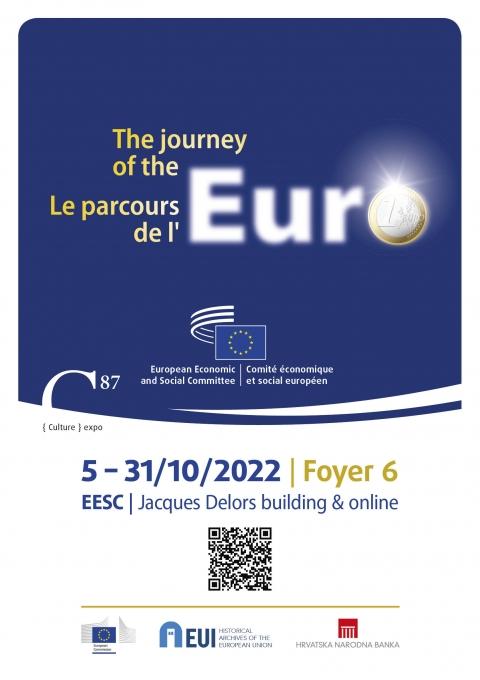
«The Journey of the Euro» se compone de una serie de imágenes que ilustran la historia del euro, combinando material de los Archivos Históricos de la Unión Europea, información facilitada por la Comisión Europea y piezas del Banco Nacional de Croacia.
Ahora que se debate la posible introducción de un euro digital, las celebraciones del vigésimo aniversario del euro coinciden con un aumento del número de Estados miembros que utilizan el euro como su moneda, ya que está previsto que Croacia se adhiera a la zona euro el 1 de enero de 2023.
El proyecto invita a los visitantes a ser testigos del viaje desde el concepto inicial hasta la introducción de los billetes y monedas de euro y anima a la audiencia a reflexionar para comprender plenamente la importancia de contar con una moneda única. Es simultáneamente un símbolo de paz y el ejemplo más tangible de la integración europea.
La exposición se puede visitar en el CESE del 5 al 31 de octubre de 2022. (ck)