Merely consulting organised civil society on the Conference on the Future of Europe will not be enough. Its participation must be meaningful and its input must shape the Conference's decisions, said speakers at the opening of the 2021 EESC Civil Society Days.
The European Economic and Social Committee (EESC) agrees with the Commission's proposal on renovation, stressing that it will improve people's well-being.
Members of the European Economic and Social Committee (EESC) and representatives of the Montenegrin organised civil society held on the 1st March the 14th meeting of the EU-Montenegro Joint Consultative Committee (JCC), which took place online. Members of the JCC adopted a joint declaration urging the EU to assist Montenegro to face the devastating consequences of the COVID-19 pandemic in the country.
El ComitéEconómico y Social Europeo (CESE) respalda el paquetefinanciero digital propuesto por la ComisiónEuropea. Si bien es cierto que la digitalizaciónbrindagrandesoportunidades, tambiénpresentariesgos para el sector financiero de la UE, que no puedenpasarse por alto y requieren una rápidaactuación.
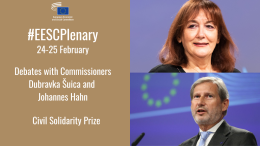
24 February, 2.45 pm DubravkaŠuica, European Commission Vice-President for Democracy and Demography, will bring the EESC up to speed on the Conference on the Future of Europe, which looks set to begin soon with the end of the stalemate over the presidency and the Council position out in the open.
25 February, 10 am Johannes Hahn, European Commissioner for Budget and Administration, will hear the findings of a pan-European EESC investigation into the Involvement of organised civil society in the national recovery and resilience plans– What works and what does not? An EESCresolution flagging areas where more civil society engagement would make for better national plans will be put to the vote straight after the debate.
25 February, 11 am The EESC plenary will review the Committee's role and action during the COVID-19 pandemic and celebrate the impressive solidarity demonstrated by civil society across Europe in its many forms through the winners of the EESCCivil Solidarity Prize.
On behalf of the European Economic and Social Committee I want to congratulate Ms NgoziOkonjo-Iweala on her appointment as Director-General of the World Trade Organization and I wish her a successful mandate. This appointment in itself brings wind of a much awaited change and marks a historic achievement.
At a high-level roundtable held by the European Economic and Social Committee (EESC), Committee members and stakeholders stressed that renovation could help Europe emerge from the crisis, but that it needs to be accompanied by measures on poverty.
A pesar de constituirse como una de las partes del Convenio de Aarhus en 2005, la Unión Europea sigue sin cumplir plenamente sus disposiciones en lo referente al «acceso a la justicia». En su Dictamen aprobado el 27 de enero, el Comité Económico y Social Europeo (CESE) acoge favorablemente la propuesta de la Comisión de revisar la aplicación del Reglamento de Aarhus en la UE como un paso adelante para mejorar el acceso de los ciudadanos y las ONG a los procedimientos de recurso administrativo y judicial en materia de medio ambiente. Sin embargo, la Comisión no va lo suficientemente lejos. Las organizaciones de la sociedad civil piden a la UE unos mecanismos de ejecución más potentes para cumplir eficazmente el Convenio de Aarhus y el Pacto Verde Europeo.
In response to the Commission Communication Stepping up Europe's 2030 climate ambition, the European Economic and Social Committee (EESC) reaffirms that the Commission's decision to raise the EU's ambition on reducing greenhouse gas (GHG) emissions to at least 55% below 1990 levels by 2030 is the right one. However, in its opinion Stepping up Europe's climate ambition, the EESC insists on increasing efforts to achieve the intermediate targets, speeding up the process and placing the European citizens at the centre of climate action. Failing this, the EU will be at risk of missing its climate-neutral goal by 2050.
The European Economic and Social Committee (EESC) stresses that a greener and fairer economy is needed and that the EU Clean Hydrogen Strategy provides an opportunity to achieve exactly that.