Granting full Schengen status to Bulgaria and Romania will also benefit the EU single market, as any limitations on freedom of movement within the EU adversely affect EU competitiveness and hamper its economic growth
The conference on disinformation, held by the European Economic and Social Committee (EESC), showcased that a horizontal approach leveraging on citizens in the fight against disinformation is moving in the right direction. The participants also pointed out that regional press can be a role model for big media platforms to rebuild the trust lost with their audiences.
Montenegro has a good chance of closing all chapters of its EU accession negotiations by the end of 2026, according to the EU-Montenegro Civil Society Joint Consultative Committee. To this end, it needs a cross-party and broader social dialogue.
The European Economic and Social Committee (EESC) held a public hearing on the situation of Roma women, exploring ways to tackle the key challenge of under-representation while addressing the different kinds of discrimination this group faces on a daily basis.
The European Economic and Social Committee (EESC) is actively participating in COP29 in Baku, Azerbaijan, from November 11–22, 2024. Representing the voices of civil society, the EESC is committed to ensuring that marginalized and vulnerable groups are included in global climate solutions.
A conference held in Estonia highlighted that low-carbon hydrogen is a key component of the energy transition and can make it happen, but it needs infrastructure and financing to develop its potential.
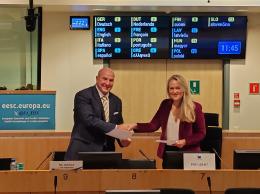
En una Declaración conjunta, firmada el 14 de noviembre de 2024, Baiba Miltoviča, presidenta de la Sección de Transportes, Energía, Infraestructuras y Sociedad de la Información (TEN) del CESE, y Andres Jaadla, ponente de un Dictamen del CDR sobre la vivienda, instan a las instituciones europeas a adoptar medidas urgentes para sacar a la Unión Europea de la actual crisis de la vivienda. También acogen favorablemente el nombramiento de un comisario europeo de Energía y Vivienda, que se encargará de presentar el primer plan europeo de vivienda asequible.
The European Economic and Social Committee (EESC) calls on the EU to champion an innovative, sustainable, and circular bioeconomy model that aligns with the European Green Deal and climate goals. In its recent opinion, Aligning the circular economy and the bioeconomy at the EU and national level,adopted at the October plenary, the EESC outlines how a strong bioeconomy strategy can amplify Europe’s economic and ecological benefits, strengthen resilience, and support a fair transition for all.
The European Economic and Social Committee (EESC) has adopted an opinion that aims to safeguard citizens' fundamental rights in the midst of the implementation of AI technology in public services.