
European Economic
and Social Committee
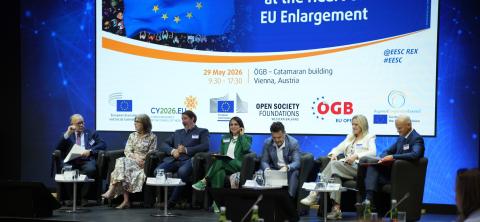
On 29 May, the European Economic and Social Committee held a conference in Vienna ─ just a few days before the EU-Balkan Summit ─ sending a clear message: civil society is key for building trust between institutions and citizens and between the European Union and the region.
Under the auspices of the Cyprus Presidency of the Council of the EU, the conference brought together more than 100 participants: Western Balkan stakeholders and representatives from the EU institutions and Austria’s civil society and government. It was organised in cooperation with the European Commission, the Open Society Foundation – Western Balkans (OSF-WB) and the Regional Cooperation Council (RCC).
Speakers pointed out that it is a communication challenge, not just a political one, because according to Eurobarometer, two thirds of EU citizens say they do not feel well informed about enlargement. Ulrike Hartmann, the Special Envoy for Southeast Europe and EU Enlargement at the Federal Ministry for European and International Affairs of the Republic of Austria, emphasised the role of reciprocal communication between Member States and candidate countries as a crucial way to rebuild trust and demonstrate the benefits of enlargement both ways.
Furthermore, the Eurobarometer showed that 53% of EU citizens are in favour of further EU enlargement, with support particularly high among young people. However, the support varies significantly by country. For example, even though the political authorities in Austria strongly support enlargement, only 38% of its citizens are in favour. That is why Vienna was chosen as the host city for the conference to raise awareness of the benefits of EU enlargement among the Austrian public.
‘EU enlargement is a geopolitical imperative for a stronger, more secure and more prosperous Europe, but we can’t take the support of citizens in the EU or the Western Balkans for granted,’ said EESC President Séamus Boland. ‘Civil society must be at the heart of this process, building bridges between the EU and the Western Balkans and helping deliver the reforms and prosperity that enlargement can bring.’
Thomas Waitz, Member of the European Parliament, said: ‘Civil society is one of the most crucial pillars of the EU enlargement process and an important partner for me as a politician. Civil society must be firmly embedded in the reform process through a genuine and inclusive exchange and be trusted to hold politics accountable.’
Andi Dobrushi, Director of OSF-WB, explained that enlargement should not be seen as a charity project but as a contribution from the Western Balkans to the EU. He added that civil society organisations should be involved before the accession arrangements are finalised and not after.
The conference conclusions were sent to European Council President António Costa and the Cyprus Presidency ahead of the EU-Western Balkans Summit which took place in Montenegro on 5 June.(at)