This public hearing will gather the view of international institutions, environmental law experts and the European and Ukrainian civil society stakeholders on the EU's approach to protecting and enhancing a healthy environment for all.
On 13 February 2023 the Section for Transport, Energy, Infrastructure and the Information Society (TEN) of the European Economic and Social Committee (EESC) hosted an online public hearing in the context of its ongoing exploratory opinion at the request of the Swedish Presidency of the Council of the EU on Wooden construction for CO2 reduction in building sector. The opinion is focusing on the following issues: How can the EU proposals such as Sustainable carbon cycles, the EU's bioeconomy strategy and the New European Bauhaus be used to drastically reduce the large construction-related CO2 emissions, store CO2 and make construction more efficient?
The Commission and the High Representative adopted in October 2022 the Joint communication Youth Action Plan in the European Union external action for 2022-2027, the first-ever policy framework for a strategic partnership with young people around the world to build a more resilient, inclusive and sustainable future. It will help deliver on international commitments, such as the United Nation's 2030 Agenda for Sustainable Development and the Paris Climate Agreement, by enhancing meaningful youth participation and empowerment in the EU's external action policies.
The Youth Action Plan (YAP) in EU External Action is guided by three pillars of action that will help shape the EU's partnership with young people in partner countries:
partnership to engage: increasing young people's voices in policy and decision-making;
partnership to empower: fighting inequalities and providing young people with the skills and tools they need to thrive;
partnership to connect: fostering opportunities for young people to network and exchange with their peers worldwide.
Hearing "YAP to youth worldwide: Next step – implementation!" in the framework of the EESC REX/566 opinion will focus on the implementation of YAP by hearing views of International Organisations, social partners and youth representatives from around the Globe.
This online public hearing on carbon removal certification aims to take stock of current certification schemes, looking at different methodologies, and discuss what an EU-wide certification framework needs to provide for in practice to make it transparent, reliable and avoid greenwashing.
A socially and economically sustainable Europe for a stronger role in the world
Event type
Public hearing
Location
Online event
1040 Brussels
Belgium
The hearing will deal with the topic of next year Strategic Foresight Report, as indicated at the end of this year report ("The next annual Strategic Foresight Report will focus on the key upcoming challenges and opportunities that Europe will face in the decades to come, providing strategic insights relevant for strengthening the global role of the EU."), so to offer to the Commission a timely and proactive input aimed to make the all process more participatory and open.
The hearing will focus on the economic and social aspects that could reinforce the role of the EU and notably on what strategic decisions need to be made to ensure a socially and economically sustainable Europe with a stronger role in the world in the coming decades.
More specifically, the hearing will discuss:
Economic sustainability understood as managing the transformation of the economy to ensure it remains within the planetary boundaries.
Social sustainability understood as the result of appropriate policies that ensure the affordability and wellbeing for current and future generations over the long-term, in order to enable the sustainability pathways.
Speakers will represent social partners and other civil society organisations as well as representatives of all the EESC Sections/CCMI so to provide a wide array of views throughout the all policy spectrum.
This hearing will focus on topical questions such as the possible avenues to help MSMEs be well informed and prepared to grasp the opportunities of the transition to climate neutrality, coupling it with the possibilities offered by the digitalisation and hedging the current geopolitical risks. It will also take into consideration the challenges faced by the Belgian companies and the opportunities offered to them if they successfully adjust to the climate neutral and digitalised world.
On 15 September 2022, the EESC's Labour Market Observatory will hold a remote public hearing on The labour market in rural areas.
The EU's rural areas are home to 137 million people representing almost 30% of its population and over 80% of its territory. The hearing will examine labour market developments and trends in rural areas and the EU's actions in this area. Through a debate with civil society organisations and socio-professional stakeholders, the event will look at the current labour market opportunities and challenges in rural areas and discuss current recommendations in the field.
Speakers due to attend include representatives of the European institutions, Eurofound and the EESC, as well as the social partners and other civil society organisations.
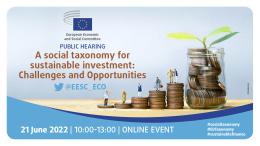
The EU´s Taxonomy Regulation establishes a framework to facilitate sustainable investment. According to the EESC, the EU taxonomy should be aligned with a holistic approach including environmental as well as social sustainability. An operationally viable and conceptually sound EU taxonomy would help to meet the urgent investment needs in the social field by channelling investments in that direction. With this hearing, the EESC wants to shed light on the idea of a social taxonomy, with the objective of stimulating the debate and come up with concrete suggestions. Conclusions will feed into an EESC own initiative opinion, currently in the drafting stage.
The market of crypto assets continues to grow, bringing with it both opportunities and challenges. Whilst it is important to harvest the potential the technological innovations offer, the associated risks have to be closely monitored. The hearing will take stock of new developments in the crypto sector, raise awareness, and come up with policy proposals to tackle emerging risks, in order to protect consumers and preserve financial stability.
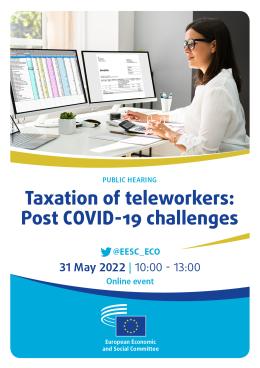
The COVID-19 pandemic has changed the lives of workers and businesses in unprecedented ways. A key change during the COVID-19 pandemic, with travel restrictions in place and governmental limitations on the number of employees present in offices in order to reduce transmission of the COVID-19 virus, has been the rise of cross-border teleworking.