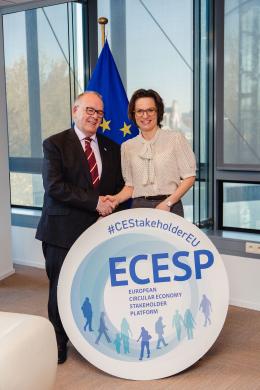
Accelerating the transition to a circular economy is not only about making Europe cleaner and more competitive, but also about achieving strategic autonomy. The European Circular Economy Stakeholders platform is set to play a crucial role in this process.
On 21st of April, the EESC Workers’ Group brought together experts from the ETUC, S&D MEPs, the Spanish government and the European Commission to examine the current push for competitiveness, the Commission’s proposals on the 28th Regime, also known as EU Inc. proposal and the Quality Jobs Act.
The European Economic and Social Committee (EESC) acknowledges the European Court of Auditors’ (ECA) performance audit report on the EU advisory bodies – the EESC and the European Committee of the Regions (CoR) – and values its recommendations.
At the 'Your Europe, Your Say!' event, participants put forward proposals to contribute to the EU's next strategy for young people. They called on the EU institutions to pay far more attention to their housing needs, the challenges of the digital sphere and their potential in political and social life.
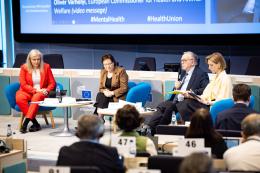
The European Economic and Social Committee (EESC) placed the emotional well-being of children and young people at the centre of its March plenary session, holding a major three-part flagship debate that brought together EU institutions, international organisations, civil society and youth representatives. Speakers urged a coordinated push for prevention, safer digital spaces and stronger community support to protect young people’s emotional well-being.
The debate held at the EESC March plenary highlighted the importance of stronger civil-military cooperation aimed at building trust. Military mobility is the key component of European independence and must focus on infrastructure, social respect and borders.
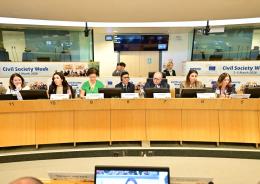
Following the third edition of Civil Society Week, the EU’s largest annual gathering of civil society representatives, the EESC reviewed its key outcomes in a plenary debate with EU institutions and stakeholders. With democratic values under growing pressure globally and across parts of the EU, civic participation is more important than ever.
The 2026 Civil Society Week organised by the European Economic and Social Committee (EESC) concluded on Thursday 5 March with the achievement of an important milestone. The stage is now set for the EESC to take part in the Commission's Civil Society Platform and host its annual summit.
After 14 successful years, the European Citizens' Initiative (ECI) has proven that it is no longer an experiment. With four initiatives surpassing the one-million-signature threshold in 2025, the ECI carries institutional responsibility. The key question, however, is how the political system can translate one million signatures into concrete EU legislation.
The European Economic and Social Committee (EESC) has launched the 2026 edition of Civil Society Week under the theme ‘People, Democracy, Resilience – Our Future’. From 2 to 5 March, the event will bring together more than 1 300 participants, including youth organisations, activists, organised civil society representatives from across Europe, journalists and EU policymakers. Discussions will focus on tackling poverty, combating social exclusion, fostering civic engagement and bridging divides between regions and between generations to rebuild trust and strengthen social cohesion.