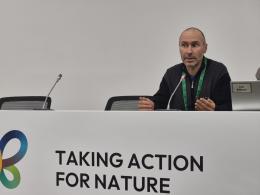
At the UN Biodiversity Conference in Yerevan, the European Economic and Social Committee (EESC) called for faster implementation of global biodiversity targets, stronger civil society participation and more effective financing to protect and restore nature.
The European Youth Forum marked its 30th anniversary at the European Economic and Social Committee (EESC) in Brussels on 12 November 2026. Bringing together generations of youth representatives, partners and representatives of the European institutions, the celebration looked back on three decades of youth engagement and explored how young people can continue to shape Europe's future.
Rising defence budgets and new EU funding programmes will not automatically make Europe more secure. A EESC hearing stresses that companies need predictable orders, easier access to the defence market and stronger industrial cooperation to turn investment into equipment and technology.
An interview with Nicoletta Merlo, president of the EESC Youth Group, on strengthening participation of young people in democratic life and ensuring greater fairness between generations
Is Europe condemned to keep pushing the same rule of law boulder uphill, only to watch it roll back down? At the EESC's seventh annual conference on fundamental rights and the rule of law, civil society and EU representatives called for stronger follow-up to identified shortcomings, as the EU considers a closer link between rule of law recommendations and funding under its next long-term budget.
The European Economic and Social Committee (EESC) has recommended that the EU’s forthcoming Digital Fairness Act strengthen protection against manipulative online practices, clarify businesses’ obligations and improve enforcement, while harmonising rules in one rulebook so that companies can scale up and the digital single market can be completed.
Better jobs can mean a stronger economy. At the Socio-Economic Value of Job Quality conference, jointly organised by the European Commission and the EESC, findings from the European Employment and Social Outlook 2026 highlighted the links between job quality, productivity and economic resilience. Against this backdrop, the EESC is calling for a comprehensive approach combining fair wages, secure employment, skills, safe working conditions and strong social dialogue.
As the EU conducts its regular revision of its employment guidelines, the European Economic and Social Committee (EESC) stresses that the rights of workers must not be jeopardised amid a push to prioritise deregulation. Ensuring the security and fair treatment of workers is particularly relevant when dealing with the increasing prevalence of AI systems, complex subcontracting and gender imbalances in the workplace.
Europe has no shortage of strategies, ambitions or recommendations. What it urgently needs is stronger implementation and tangible results. In its opinion on the 2026 European Semester Spring Package, adopted at its October plenary, the European Economic and Social Committee calls for a European Semester that drives reforms, strengthens productivity and turns shared priorities into real improvements for businesses, workers and citizens.
As Europe marks Gender Equality Week 2026, the European Economic and Social Committee (EESC) is highlighting its long-standing commitment to advancing gender equality through its most recent policy work, civil society engagement and international action. From equal pay and economic independence to reproductive rights, participation and the fight against gender-based violence, the Committee continues to press for commitments to be turned into concrete and measurable progress.