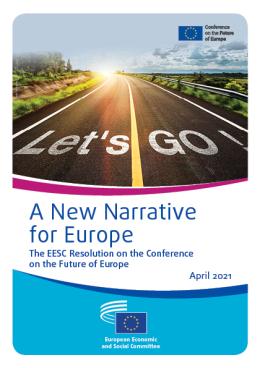
The European Economic and Social Committee adopted at its April plenary session a resolution on the Conference on the Future of Europe in which it calls on "a new narrative grounded on the realities of everyday life" to reconnect and engage with European citizens. For this, according to the resolution, it is essential to ensure that organised civil society is involved and plays a major role.
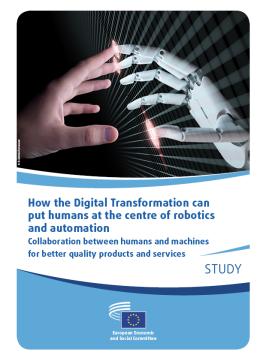
Digital Transformation (DT) is changing the economy, remodelling the business activities, transforming the world of work and, more in general, affecting common daily activities such as communicating, shopping, researching. Despite the remarkable effort of the EU in encouraging the use of advanced technologies, EU businesses are not currently taking full advantage of them or of the innovative business models offered by the collaborative economy.
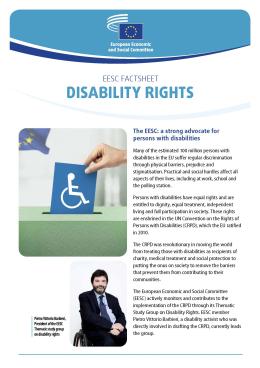
This factsheet provides an overview of the work carried out by the EESC over the past few years to promote the rights of persons with disabilities, particularly in the areas of employment, accessibility, multiple discrimination and the full exercise of the right to vote in European elections - a fight the EESC is now preparing to take to the next level to achieve meaningful change before the next European elections.
The European Circular Economy Stakeholder Platform is a joint initiative by the European Commission and the European Economic and Social Committee (EESC), launched in March 2017. The two institutions are working closely together to promote the Platform as a space for the exchange of ideas and a growing body of information, and to make the circular economy happen faster to the benefit of all. At the EESC, the Platform is spearheaded by three Members: Anders Ladefoged (Group I: Employers), Maria Nikolopoulou (Group II: Workers) and Cillian Lohan (Group III: Diversity Europe).
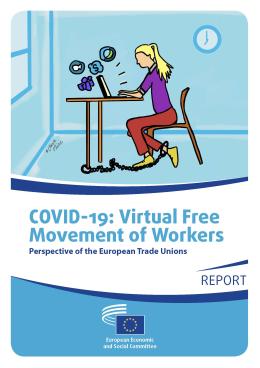
The interrelation between telework and the COVID-19 pandemic has offered a completely new insight into the traditional organisation of work and led to the development of the phenomenon referred to as the ‘new normal.’ By focusing on the EU workforce, this thesis investigates how TICTM (Telework and Information and Communication Technology-based Mobile Work) has shaped their behaviour during COVID-19 from the point of view of European trade unions.