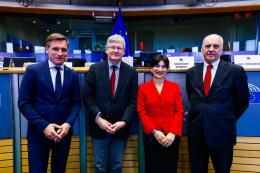
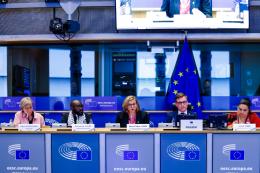
On 17 July, the President of the European Economic and Social Committee (EESC), Oliver Röpke, signed a Memorandum of Understanding (MoU) with the African Union Economic, Social and Cultural Council (ECOSOCC) represented by its Presiding Officer, Khalid Boudali. The memorandum aims to formalise the partnership between the two institutions and enhance economic and social stakeholder involvement in the Africa-EU partnership.
The European Economic and Social Committee (EESC) is calling for the Commission's proposal on making EU traineeships fairer and more inclusive to be reinforced. Nearly half of the EU’s more than three million trainees are unpaid and almost a third have no access to social protection. All young people should have the chance to benefit from the traineeship experience - not just those who can afford it
The European Economic and Social Committee (EESC) adopted a resolution during its July plenary session rejecting the idea of transforming cohesion policy into a mechanism similar to the Recovery and Resilience Facility (RRF). The EESC calls for cohesion policy to be strengthened and for civil society to be involved, just as it was for the 2021-2027 programming period.
The European elections proved that the pro-European majority still holds, but also showed that voters across the EU demand urgent political and legislative responses to the challenges raised in the electoral campaign. Otherwise, the pro-European majority may risk losing support as citizens may increasingly turn their backs on the mainstream political forces.
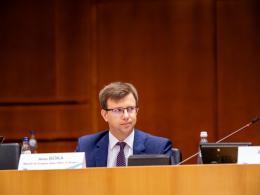
At the July plenary session of the European Economic and Social Committee (EESC), Committee president Oliver Röpke hosted a debate with the Hungarian Minister for European Union Affairs,János Bóka, who presented the main priorities of the Hungarian Presidency of the Council of the EU.
En su conferencia anual sobre la pobreza energética, el Comité Económico y Social Europeo (CESE) hizo balance del alarmante aumento del número de personas en situación de pobreza energética durante el último año. El CESE envía un mensaje firme a los dirigentes de la UE y presenta propuestas concretas para lograr un suministro de energía asequible y estable, apoyando al mismo tiempo a las personas vulnerables, los hogares y las pymes.
Tan solo unos días después de las elecciones europeas de 2024, el Comité Económico y Social Europeo (CESE) y los consejos económicos y sociales (CES) nacionales de la UE se reunieron para debatir la situación de la doble transición digital y ecológica que se está desarrollando. Han llegado a la conclusión de que la sociedad civil organizada desempeña un papel decisivo para ayudar a subsanar las deficiencias.
At its May plenary, the European Economic and Social Committee (EESC) discussed lessons learned from the 2004 EU enlargement. The current geopolitical and security situations make further enlargement an even more urgent task for Europe.
With hate speech and hate crime rising at a frightening rate, Europeans are joining forces and stepping up action against all forms of hatred to send the message that there is no place for hate in the EU
The European Economic and Social Committee (EESC) has adopted two opinions at its May plenary, emphasising the crucial role of cohesion policy – the EU’s primary funding instrument for regional development – in future enlargements. The EESC calls for, among others, compliance tools to be included in accession treaties to address potential post-accession challenges, such as emigration and rule of law concerns.