The Capital Markets Union (CMU) is an initiative that was launched in 2014 with the aim of creating a single market for capital in the EU. Today, despite concerted efforts towards more integrated capital markets, such as the 2015 and 2020 Action Plans, the CMU remains incomplete. Yet, recent developments offer hope for renewed momentum. The statement of the Eurogroup in inclusive format on the future of the CMU, and the report "Much more than a market", by Enrico Letta, outline fresh proposals on how to further integrate financial markets in the EU and stimulate investment. Against this backdrop, this public debate will convene institutional actors and civil society stakeholders to take stock of current developments and discuss policy solutions for the upcoming parliamentary term.
A few days after the European Parliament elections, in a new political and institutional environment, the EESC is organising in cooperation with the Central Council of the Economy (CCE) and the National Labour Council (CNT) of Belgium a joint Seminar on: 'Transitions towards a digital, green, just and competitive Europe: the role of social and civil dialogue.' This seminar will be held on 20 June 2024 and be open to the public.
The 11th meeting of the EU DAG, which took place right after European elections and ahead of UK general election, was dedicated to members’ presentations on pressing ongoing issues, including CBAM, concerns around labour rights LPF and non-regression, the sand eel dispute and the transport of live animals and common veterinary.
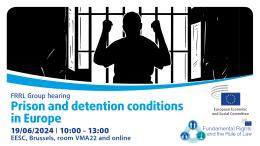
Hearing of the Fundamental rights and Rule of law Group
Location
EESC, Rue Belliard 99, 1040
Brussels
Belgium
This hearing will examine the current state of prisons and detention centers in Europe, focusing on the experiences of inmates, detainees, and the working staff. The event will review existing regulations for these facilities and assess their practical implementation, to determine whether they uphold human rights standards adequately. Thanks to the participation of relevant stakeholders, the hearing seeks to identify gaps and challenges in the system, by comparing the laws with on-the-ground realities.
The 2024 annual meeting of presidents and secretaries-general of the ESCs of the EU & the EESC will be held on 19 June 2024. The meeting will tackle following topic "From words to action: the role of organised civil society in implementing and assessing public policies - the twin transition".
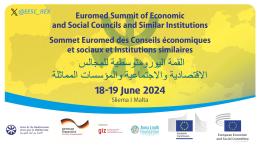
The annual Euro-Mediterranean Summit of Economic and Social Councils and Similar Institutions provides civil society organisations (CSOs) from the UfM Member States with a platform to debate common challenges and opportunities and to exchange best practices.
Domestic Advisory Groups of the EU and six Central American countries held their Joint Meeting in Brussels on 17-18 June. The DAGs took part in a Workshop focused on two pertinent topics: Corporative Sustainability Due Diligence and the EU Deforestation Directive. During the Joint Meeting the DAGs discussed their role and functioning, in particular in view of the full application of the Association Agreement. The delegates exchanged good practices and debated the consequences of the full application of the AA for civil society sensu largo and on the work of the DAGs. Important part of the discussion was dedicated to the space for democracy and the role of civil society and advisory groups in strengthening democracy and rights.
Representatives of the European and Georgian Domestic Advisory Groups (DAGs), set up under the Trade and Sustainable Development Chapter of the Association Agreement between the European Union and Georgia, will hold their eighth joint meeting on 17 June 2024 in Brussels.
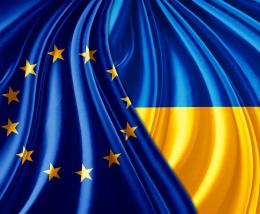
The 15th meeting of the EU-Ukraine Civil Society Platform (CSP) took place on 14 June 2024. During the meeting, the CSP members exchanged with the EU and Ukrainian authorities on the implementation of the European Commission's opinion on Ukraine's EU membership and on the state of play of the implementation of the EU-Ukraine Association Agreement.