For the 19th time, the European Economic and Social Committee (EESC) and Montenegro held the Civil Society Joint Consultative Committee (JCC) in at the EESC in Brussels on 27 November 2024. The JCC is a civil society platform established between the EESC and Montenegrin civil society. It complements with a civil society point of view the EU institutional framework related to the Stabilisation and Association Agreement between the EU and Montenegro. This joint institution allows civil society organisations on both sides to monitor the country's accession negotiations. It is also a platform to discuss issues of common interest and to inform the public at large on the challenges ahead during the accession period.
Main topics of the 19th meeting of the EU-Montenegro JCC were:
Current state of play in EU-Montenegro relations: 2024 Enlargement Package and Montenegro Report, overview of the developments within the Berlin process
Reform Agenda (RA) for Montenegro and the implementation of the New growth plan for the Western Balkans
Montenegrin roadmap for fulfillment of the negotiation chapters’ closing benchmarks after the IBAR
Overview of the civil society situation in Montenegro, including social dialogue
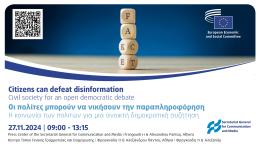
Press Center of the Secretariat General for Communication and Media, Frangoudi 11 & Alexandrou Pantou | Athens, Greece
This conference in Athens is the third event on disinformation being hosted by the European Economic and Social Committee (EESC) as part of its ongoing project aiming to fight disinformation with the help of civil society.
The aim of the meeting is to gather key experts to discuss what needs to be done to alleviate the societal burden of the extraordinary rise of the cost of living.
During the meeting, the EU DAG will receive an update from DG Trade on the EU-Korea FTA and the implementation of the TSD Chapter. EU DAG members and DG Trade will report back from the Civil Society Forum and workshop held in September 2024. In addition to that, European Chamber of Commerce in Korea (ECCK) will make a presentation on this year's ECCK White Paper, and the EU DAG will discuss current situation in South Korea in light of the geopolitical situation with Professor Ramon Pacheco Pardo.
The 14th meeting of the EU-Moldova Civil Society Platform took place on 15 November 2024. During the meeting, a debate focused on assessing the progresses of Moldova in the implementation of the Association Agreement and the European Commission's recommendations regarding its accession to the EU.
As in the previous years, the European Economic and Social Committee (EESC) will actively take part in the annual United Nations Framework Convention on Climate Change – COP29, which this year will take place in Baku, Azerbaijan, from 11 to 22 November 2024.
This event is an in-person conference that will be live streamed on our website. Registration is closed. We kindly invite you to follow the live webstream.
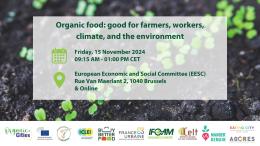
On 15 November the EESC will host a pivotal event focusing on the benefits of organic food and the critical role of public procurement in advancing sustainable practices. This event will bring together representatives from cities, national governments, and institutions to discuss the future of organic farming and its impact on farmers, workers, the climate, and the environment.
Whilst several actions have been taken at EU level in favour of gender equality, inequalities still prevail, with Roma women facing additional challenges as a result of poverty and social exclusion. The hearing will discuss measures that could help empower Roma women and how their participation in employment, which is still very low, can be reinforced. It will address the question of early marriages, the extent to which this is still predominant amongst the Roma community and measures how this phenomenon can be curbed.