Newsletter Info

EESC info

European Economic and Social Committee A bridge between Europe and organised civil society

JANUARY 2026 | EN

GENERATE NEWSLETTER PDF

Available Languages:

  • EN

For other languages, please click on the title of each article. Translation is provided by the European Commission's eTranslation service.

Editorial
WE MUST STAND UP FOR THE VALUES THAT UNITE US

EDITORIAL

Dear readers,

The opening days and weeks of 2026 have certainly further demonstrated that we are living in very challenging and unnerving times. Many of the things that we took for granted are no longer guaranteed. Geopolitical fundamentals including territorial integrity and respect for international organisations are being questioned. 

Read more in all languages

WE MUST STAND UP FOR THE VALUES THAT UNITE US

Dear readers,

The opening days and weeks of 2026 have certainly further demonstrated that we are living in very challenging and unnerving times.

Many of the things that we took for granted are no longer guaranteed. Geopolitical fundamentals including territorial integrity and respect for international organisations are being questioned. And we are rapidly approaching the fourth year of war on the European continent.

But my strong message to you for the year ahead is this: Do not abandon positive thinking and hope. We must stand up for what we believe in, for the values that define and unite us, and which provide the foundations for the European project. For freedom and peace. For democracy, which we know is not possible without a strong and active civil society. For human rights and dignity. 

These are topics I had the great honour to discuss with His Holiness Pope Leo XIV during a private audience on 10 January.

It was a true privilege to hear first-hand the insights that underpin Pope Leo's moral leadership and to have the opportunity to convey the EESC's vital role in European democracy, and our priorities: the need for poverty eradication, safeguarding democracy and protecting the most vulnerable.

In a European Union of immense wealth, the fact that 21% of people remain at risk of poverty or social exclusion is simply not acceptable. Tackling poverty and related challenges such as the affordable housing emergency will be key priorities in 2026.

My exchange with Pope Leo XIV also addressed the profound challenges facing the younger generations, shaped by the isolation of the COVID-19 pandemic and mental health pressures amplified by social media.

This is linked to the advance of artificial intelligence. Ensuring that AI does not become a runaway train when it comes to workers' rights is a priority in 2026. It must serve as a tool for empowerment rather than displacement. On this topic, I share a commitment with Pope Leo to ensuring that humans – not machines – remain in control of decisions that affect people's lives.

My strongest reflection from my meeting with Pope Leo is the absolutely vital role of civil society in not only strengthening democracies but building and nurturing communities. Civil society organisations, including the social partners, are the fabric of our societies, knitting together individuals and building bridges across groups.

Civil society therefore remains essential to renewing hope and building a Union of opportunities, security, and resilience. 

This is a message that I have also been sharing in meetings with countless EU high-level figures since becoming president. These include European Council President António Costa, European Parliament President Roberta Metsola, several key Commissioners, and numerous vice-presidents and committee chairs in the European Parliament.  

I am grateful to Pope Leo for using his powerful voice to spread a message of inclusion globally and of the need to protect the most marginalised. Irrespective of religious views, what great moral and political leaders have in common is their fervent belief in hope and human dignity and their respect for others.

Together, let us carry this outlook with us in the year ahead. In our efforts to put civil society at the heart of Europe, let us choose hope over fear.

Séamus Boland

President of the European Economic and Social Committee

Diary Dates

20 January

EU-Viet Nam FTA meeting

26 January

Public hearing - A comprehensive strategy for nature-based biodegradable materials

29 January

Public hearing - Union of Equality: LGBTIQ+ Equality Strategy 2026-2030

4 February

Public hearing - Capital markets integration and efficient supervision

5 February

Public debate - Bulgaria, welcome to the euro area! – Embracing the common currency in a changing world

12 February

Public hearing - A Culture Compass for Europe

18-19 February

EESC plenary session

THE SURPRISE GUESTS

In this issue, our surprise guests are Georgian journalist Irma Dimitradze and Serbian student Stefan Tomić. 

At the award ceremony for the Sakharov Prize for Freedom of Thought organised by the European Parliament in Strasbourg, Irma Dimitradze stood in for 2025 laureate Mzia Amaglobeli, Georgia’s first female journalist to become a political prisoner, now jailed for more than a year. 

Stefan Tomić spoke to us in Strasbourg about the massive student-led protests that have been shaking Serbia since late 2024.  Serbian students protesting against government corruption and impunity at home were finalists for the Sakharov prize, together with journalists and humanitarian workers in Palestine and all conflict zones.

Read more in all languages

In this issue, our surprise guests are Georgian journalist Irma Dimitradze and Serbian student Stefan Tomić.

At the award ceremony for the Sakharov Prize for Freedom of Thought organised by the European Parliament in Strasbourg, Irma Dimitradze stood in for 2025 laureate Mzia Amaglobeli, Georgia’s first female journalist to become a political prisoner, now jailed for more than a year.                  

For EESC Info, Irma writes about the collapse of Georgia’s democracy and the rise of a pro-Kremlin authoritarian regime that imprisons protesters, targets journalists and crushes the country’s European hopes. However, Georgia’s democratic decline is no isolated event; it is part of a wider push by authoritarian forces that edge closer to Europe each day.

Also nominated for the Sakharov prize were journalists and humanitarian workers in Palestine and all conflict zones, along with Serbian students who have been protesting against government corruption and impunity at home. Student Stefan Tomić spoke to us in Strasbourg about the massive student-led protests that have been shaking Serbia since November 2024.

@netgazeti

2026 AND THE WAR ON DEMOCRACY: LESSONS FROM GEORGIA

By Irma Dimitradze

2026 did not arrive quietly. In Georgia, it arrived with a growing number of political prisoners, a frozen European future, and a country sliding toward authoritarian rule. For me, that reality has a name: Mzia Amaglobeli. One year ago, my mentor and close friend became Georgia’s first female journalist political prisoner.

Read more in all languages

By Irma Dimitradze

2026 did not arrive quietly. In Georgia, it arrived with a growing number of political prisoners, a frozen European future, and a country sliding toward authoritarian rule.

For me, that reality has a name: Mzia Amaglobeli. One year ago, my mentor and close friend became Georgia’s first female journalist political prisoner. She was abused, assaulted, denied justice and held through a 38-day hunger strike that cost her most of her eyesight. From that moment on, my life and my country changed forever.

The collapse of Georgia’s democracy did not happen overnight. Nor was it an isolated assault. It is part of a larger war, visible when Russia launched Europe’s largest war since WWII in Ukraine, and even before that, through disinformation, propaganda and hybrid warfare.

This is a war against the rule-of-law world order itself – one that seeks to re-draw borders, crush democratic institutions and reshape our lives.

Western democracies, like Georgians, underestimated its power. They believed they were too strong, too democratic; we believed we were too resilient. We were wrong.

In Georgia, propaganda tells people that the European Union is weak in this global struggle, and that pursuing EU integration will bring Russian tanks and rockets, as in 2008. Fear has been weaponised.

However, the result is over 410 days of continuous protest. People are demanding their stolen country back after rigged elections, captured courts, mass surveillance and repressive laws. The regime grows more inventive in crushing dissent, but resistance continues.

Georgia was never perfect, but it built a vibrant civil society, a growing free media and liberal laws. After receiving EU candidate status, it was suddenly thrown off a cliff, transforming into a repressive state where people are jailed for protesting, journalists are criminalised, civil servants are fired for dissent, and protesters are allegedly poisoned with chemicals.

Since 28 November 2024, when the ruling party ‘Georgian Dream’ froze Georgia’s EU path, the country has been rapidly refashioned into a laboratory of authoritarian rule. Destruction is always faster than building.

Europe may feel sympathy, but this is not just Georgia’s loss. It is yours too. This is how authoritarianism spreads, country by country, until it reshapes the world order itself.

As 2026 begins, one thing is clear. The old rules no longer protect us. While Europe hesitated, authoritarianism advanced. Now the question is no longer whether the world will change, but whether it will be shaped by those who defend democracy or by those who destroy it.

Tonight, in the last hours of 11 January, together with my colleagues, I stood in the freezing air outside Rustavi women’s prison, where Mzia Amaglobeli, now a Sakharov Prize laureate, remains unjustly imprisoned. Exactly one year ago, at this same hour, she was first unlawfully detained for putting up a poster in protest against arbitrary arrests for the same form of expression.

Less than one month ago, I was in Strasbourg, attending meetings and giving interviews on Mzia’s behalf. Her message to the EU was urgent and simple: act now and act effectively. Use all tools at your disposal. We live in a new reality that allows no luxury to delay.

Mzia ended her letter with the words, ‘I believe in a democratic, strong Europe’. For Georgians, this belief is not symbolic. It costs freedom, safety and lives. Europe must now decide: honor it, or abandon those who hold it.

Irma Dimitradze is a journalist and Communications Manager at Gazeti Batumelebi, a Georgian media organisation co-founded in 2001 by Sakharov Prize 2025 laureate Mzia Amaglobeli. She led an investigative report exposing the ruling party’s access to tens of thousands of voters’ sensitive personal data, which should only be collected by state institutions. Ms Dimitradze advocates internationally for Georgian press freedom and for Mzia Amaglobeli, the country’s first female journalist political prisoner since 1991.

WE ARE FIGHTING AGAINST THEFT, MURDER, CORRUPTION… AND FOR DEMOCRACY AND EQUAL RIGHTS FOR ALL

On 1 November 2024, a newly renovated concrete roof collapsed on the railway station in Novi Sad in Serbia, killing 16 people and seriously injuring another one. The tragedy, widely blamed on construction negligence and government corruption, sparked what would become one of the largest civic movements in Serbia’s recent history. Students were the first to respond, taking to the streets and organising vigils, protests and blockades of roads and universities as they called for change. We spoke with student protester Stefan Tomić during the Sakharov Prize award ceremony.

Read more in all languages

On 1 November 2024, a newly renovated concrete roof collapsed on the railway station in Novi Sad in Serbia, killing 16 people and seriously injuring another one. The tragedy, widely blamed on construction negligence and government corruption, sparked what would become one of the largest civic movements in Serbia’s recent history. Students were the first to respond, taking to the streets and organising vigils, protests and blockades of roads and universities as they called for change. Many were beaten or arrested by the police. In 2025, Serbian students were nominated for the European Parliament's Sakharov Prize for Freedom of Thought. During the award ceremony in Strasbourg, we spoke with student protester Stefan Tomić, who was among those detained by Serbian police.


During the panel organised with civil society organisations when the Sakharov Prize was awarded in Strasbourg, you mentioned that the student protests in Serbia were in fact initiated by just one young woman after the terrible tragedy in Novi Sad. In your opinion, how and why did the protest grow to such massive proportions?

Until now, protests in Serbia have been organised by opposition parties or other interest groups. This time it’s different: the tragedy stirred emotions that were strong enough for us to take action on our own, without any other interests. That’s why the young woman started the first blockade, that’s why, after seeing her, we jumped in, and that’s why Serbia trusts us. That’s why the protests are massive.

Your fellow student Dimitrije Dimić said in Strasbourg that your student movement has in fact no leader. How do you gather and organise? What would have to happen for you to decide to end the protests?

We hold assemblies at the faculties, then there is a kind of coordinating structure above that and decisions are made democratically. We trust those decisions the way someone would trust a leader, and that is why we don’t even need a leader. In answer to your question about ending the protests, it’s simple: our demands must be met.

How have the authorities and police of the Republic of Serbia responded to the student protests? You yourself were arrested and placed under house arrest. How did your arrest happen, and what exactly were you charged with?

They arrested me out of the blue. They didn’t give me a summons or a lawyer. After five hours, I assume the outside pressure became strong enough that they had to grant me my basic rights. I then found out that I was being charged with inciting a violent change of the constitutional order, and I was detained for two days. After that, my house arrest began. The police have not been gentle at all; they have beaten us many, many times over the past year.

Some of your lawyers were with you in Strasbourg. What kind of legal help are the students receiving from the lawyers? Who else has supported you? How are you portrayed in the Serbian media?

The lawyers were among the first to go on strike, and now, when we are arrested, it means a lot to have a good lawyer. We have received support from practically every group in Serbia, although the most visible have been teachers and professors, the IT sector, taxi drivers and bikers. But this is not thanks to the media. All TV stations holding nationwide broadcast licences claim that we are paid mercenaries and terrorists. Nova S and N1 are the only TV stations that report objectively, and the government is doing everything it can to shut them down. Social media saved us.

Some critics still claim that no one actually knows what the student protesters’ programme is or what you stand for. How would you respond to that?

More than a year has passed. Earlier, I could attribute such statements to ignorance; now I am sure they are malicious. We are fighting against theft, murder, corruption… We are fighting for democracy, equal rights for all. We are fighting for the fulfillment of our demands. We have been fighting for the same things since the beginning. There wouldn’t be so many of us if we didn’t have a clear goal, and people wouldn’t support us if we didn’t.

Serbian students have been nominated for the 2025 Sakharov Prize. What does this nomination mean to you personally and to the other students?

It’s an incredible feeling. We are still young, and it is terrifying to do something on the scale of an entire nation without any confirmation that we are doing things the right way. Such recognition is necessary ─ for us and for everyone in the world who finds themselves in a similar situation. Thank you. From me and from all the students.

Stefan Tomić is a 20-year-old student in the Faculty of Physics, University of Belgrade. 

ONE QUESTION TO...

The right to safe abortion is still not evenly protected across the EU, with some countries restricting or even criminalising access, while others leave women unable to practically exercise this fundamental right. We asked EESC member José Antonio Moreno Díaz about the European citizens’ initiative  My Voice, My Choice, which has collected over one million verified signatures and has already been backed by the European Parliament. With its opinion, the EESC gives full support to the initiative and calls on the European Commission to act to make sure that all women in the EU can access abortion safely and without barriers.

Read more in all languages

The right to safe abortion is still not evenly protected across the EU, with some countries restricting or even criminalising access, while others leave women unable to practically exercise this fundamental right. We asked EESC member José Antonio Moreno Díaz about the European citizens’ initiative My Voice, My Choice, which has collected over one million verified signatures and has already been backed by the European Parliament. With its opinion, the EESC gives full support to the initiative and calls on the European Commission to act to make sure that all women in the EU can access abortion safely and without barriers.

RIGHT TO SAFE ABORTION: MY VOICE, MY CHOICE INITIATIVE HAS THE EESC'S FULL SUPPORT

by José Antonio Moreno Díaz

Women's right to abortion in safe, decent conditions and in a calm, trustworthy environment has long been the subject of debate and continues to be so today. The issue being debated is the freedom and autonomy that women should have over their own bodies – their privacy and personal autonomy and their sexual and reproductive freedom.

Read more in all languages

By José Antonio Moreno Díaz

Women's right to abortion in safe, decent conditions and in a calm, trustworthy environment has long been the subject of debate and continues to be so today.

It would be a mistake to try and link this right and the peaceful, safe exercise thereof to moral issues or religious or ethical beliefs that are completely outside the scope of the debate.

The issue being debated is the freedom and autonomy that women should have over their own bodies – their privacy and personal autonomy and their sexual and reproductive freedom. This is clearly part of their personal dignity as human beings.

The exercise of this right also involves health issues and the personal health of the women concerned.

Therefore, the right to abortion and the right to the genuine, free, safe exercise of abortion should be considered a fundamental right, as already recognised in some EU countries, and included in the European Charter of Fundamental Rights.

In this regard, the situation varies across the EU, where some Member States completely prohibit abortion (even criminalising it) while others severely limit this right through very restrictive regulatory frameworks on the basis of time limits or other criteria. Other countries recognise the right but it is extremely difficult to exercise due to organisational or functional problems with health and/or administrative services. In other countries, access is free without restrictions.

The question is how it can be possible that in an environment of rights and freedoms and with respect for Article 2 of the EU Treaty, these disparities continue to exist, affecting the fundamental rights of women, who make up approximately 50% of the EU population.

The proposal of the European citizens' initiative My Voice, My Choice – formally and verifiably supported by more than one million EU citizens – seeks to open this debate in a pragmatic way.

Given that the EU does not have competence in health matters and harmonisation is difficult in this field, it is proposed to create an EU budget fund to facilitate travel to another EU country and health coverage for the proper exercise of the right to abortion in that other EU country. Experience shows that only women with financial means in countries where abortion is prohibited or restricted can afford the costs of such travel, while thousands of other women who lack the financial wherewithal must either undergo unwanted pregnancies or resort to unsafe, clandestine or risky abortion practices, with serious risks to their health and integrity.

The EESC opinion fully supports the My Voice, My Choice initiative and endorses the arguments put forward by civil society in promoting this initiative, which has already been approved by the European Parliament. We hope that the Commission will shoulder its responsibility, listen to civil society, take note of this initiative and the underlying debate and take the initiative to design an EU policy instrument that facilitates access to abortion rights for all women in the EU.

TO THE POINT

The AI Act has set the rules for artificial intelligence in Europe. The challenge now is applying them effectively in businesses, public services and key sectors. EESC member Rudolf Kolbe, rapporteur of the opinion Apply AI Strategy – strengthening the AI continent, gives the EESC’s take on how Europe can turn its AI rules into practical results, all while keeping people and fundamental rights at the centre. 

Read more in all languages

The AI Act has set the rules for artificial intelligence in Europe. The challenge now is applying them effectively in businesses, public services and key sectors. EESC member Rudolf Kolbe, rapporteur of the opinion Apply AI Strategy – strengthening the AI continent, gives the EESC’s take on how Europe can turn its AI rules into practical results, all while keeping people and fundamental rights at the centre. 

APPLY AI STRATEGY: TRANSLATING EUROPE’S AI RULE INTO ACTION

By Rudolf Kolbe

With the AI Act, Europe has established an important framework. Now it needs to put it into practice: are we going to be able to deploy AI across the board – in businesses, in public administrations and in strategic sectors – and still remain human-centric, trustworthy and competitive? That’s what the European Commission’s Apply AI Strategy is all about.

Read more in all languages

By Rudolf Kolbe

With the AI Act, Europe has established an important framework. Now it needs to put it into practice: are we going to be able to deploy AI across the board – in businesses, in public administrations and in strategic sectors – and still remain human-centric, trustworthy and competitive? That’s what the European Commission’s Apply AI Strategy is all about: it shifts the focus from regulation to application, so as to increase productivity, improve public services and make us more resilient.

There are three central elements to this.

Firstly, the sectoral flagships: targeted measures for healthcare, industry and construction, robotics, energy, mobility, security, agri-food, culture and the public sector could create real demand for European solutions. 

In the health sector, AI-powered screening centres and competence networks can enable earlier diagnoses and reduce paperwork – but only if data protection, transparency and clinical validation are taken into account from the outset. In industry and construction, digital twins and AI-enabled automation can improve quality, safety and efficiency, while at the same time addressing skills shortages. Across all sectors, fairness, non-discrimination and fundamental rights must remain guiding principles.

Secondly, cross-cutting measures for SMEs and for people working with AI. 

AI use in Europe is still too low, especially among small businesses. It is therefore a good idea to strengthen the European Digital Innovation Hubs and turn them into ‘Experience Centres for AI’. However, SMEs need actual tangible support: easier access to finance, less red tape, workable rules for data use and intellectual property, and hands-on support to commercialise solutions and scale them in the single market. This includes building regional clusters of skills, based on existing strengths, so that every region can benefit – not just those that are already the strongest innovation hubs.

The world of work is just as crucial. AI literacy needs to be clearly defined and taught in practice in a sector-specific way for workers, managers and the public service. The aim of upskilling and reskilling is not just to reduce risks, but also to enable job transformation, improve job quality and increase productivity gains. Where algorithmic management and automated decision-making affect human beings, transparency, explainability and effective complaint and redress mechanisms are non-negotiable if we are to build trust.

Thirdly, governance that is inclusive and implementation-oriented. 

A coordinated mechanism – with an AI observatory that develops KPIs, monitors impacts and reports publicly – can keep the strategy on track if stakeholder engagement is balanced and time-efficient. Social partners, SMEs and civil society must be part of the solution from the outset. Additionally, Europe should use strategic public procurement to bring innovative, safe and sustainable AI solutions to the market – solutions that are transparent, competitive and technology-neutral.

Finally, ambition requires reliable investment. ‘Apply AI’ needs predictable, long-term resources for research, computing and data infrastructure, and upskilling and reskilling – particularly for SMEs and regional innovation clusters – in the 2028–2034 multiannual financial framework. Following the withdrawal of the AI Liability Directive, future measures also need to create legal certainty for innovators while at the same time protecting consumers and workers in the single market.

‘Apply AI’ could become Europe’s implementation strategy, translating our values and rules into measurable impact – but only if we pick up the pace, simplify access and make trust our central concern.

EESC News

EESC CALLS FOR BOLDER EU BUDGET AND WARNS AGAINST CENTRALISATION

The EESC is calling for a larger EU budget than proposed in the Commission’s draft 2028-2034 multiannual financial framework (MFF), which totals EUR 1.816 trillion. The EESC discussed the draft during its plenary session in December as part of the preparations for an opinion that is due in January 2026 and builds on the EESC’s April 2025 mid-term revision assessment.

Read more in all languages

The EESC is calling for a larger EU budget than proposed in the Commission’s draft 2028-2034 multiannual financial framework (MFF), which totals EUR 1.816 trillion.

The EESC discussed the draft during its plenary session in December as part of the preparations for an opinion that is due in January 2026 and builds on the EESC’s April 2025 mid-term revision assessment. The debate saw the participation of Commissioner for Budget, Anti-Fraud and Public Administration Piotr Serafin, MEP Carla Tavares and former Italian minister in the Draghi government and Scientific Director of the Italian Alliance for Sustainable Development (ASviS) Enrico Giovannini.

‘Our Union can only remain resilient if those closest to the grassroots level – regional and local actors, social partners and organised civil society – remain fully involved in shaping where and how funds are spent,’ EESC President Séamus Boland said.

During the debate, EESC members warned that merging cohesion, agricultural and fisheries funding into new national and regional partnership plans (NRPPs) could risk centralising fund management. They also highlighted the need to avoid repeating the consultation shortcomings seen with the recovery and resilience plans. Concerns were raised about linking NRPPs to European Semester priorities, which could impose undue macroeconomic conditionality.

The Committee supported using revenue from the emissions trading system and the carbon border adjustment mechanism, but opposed a new corporate levy, recommending a digital services tax instead. It called for increased funding for the European Social Fund Plus, the Just Transition Fund, Horizon Europe and the Connecting Europe Facility. The new AgoraEU programme was welcomed as a boost for culture, media pluralism, democratic participation and civil society.

Clearer targets, transparency and greater local involvement would bolster democratic governance and improve the MFF proposal.

THE SPACE SECTOR URGENTLY NEEDS TO MAKE THE EU A WORLD LEADER

The EESC is calling for immediate structural measures in space investment and recommends increasing this to at least 0.2% of the EU’s GDP by 2030. Europe’s investment in space is currently significantly smaller than that of its main competitors.

Read more in all languages

The EESC is calling for immediate structural measures in space investment and recommends increasing this to at least 0.2% of the EU’s GDP by 2030.

In the opinion drawn up by Angelo Pagliara and adopted during its December plenary session, the Committee points out that this boost would allow Europe to gradually close the gap with the US and China, making the EU a world leader in the space sector.

Europe’s investment in space is significantly smaller than that of its main competitors. The EU currently allocates only 0.07% of its GDP to space activities, compared to an average of 0.25% in the US, and higher levels still in China, India and Japan.

‘This structural imbalance undermines Europe’s ability to foster autonomous innovation, maintain strategic critical infrastructure and combat dependency on technologies, data and services from third countries,’ said Mr Pagliara, adding ‘We need to increase European public investment in the space sector’.

The EESC opinion assesses the European Commission’s EU Space Act and endorses its intention to enhance the space single market.

In order to make space activities sustainable, safe and resilient, the EU needs an immediate structural boost to its public investment in space activities. This means that the Union must take urgent action and adopt ambitious industrial policies, otherwise the objectives of the Commission’s proposal will not be met.

At the same time, the EESC underlines that it is important to have a clear regulatory framework in place to attract private investment. This must go hand in hand with an industrial and technological strategy that maximises economic and social returns for Europeans, defines tools to reduce dependency on critical supplies from outside Europe and supports the development of European launch capabilities. (mp)

EESC BACKS COMMISSION’S PROPOSED STRATEGY BUT CALLS FOR MORE COMPETITIVE AND SIMPLIFIED SINGLE MARKET

The European Economic and Social Committee (EESC) has endorsed the European Commission’s new strategy to overhaul the single market, while calling for fully-fledged implementation of single market-related measures and effective enforcement of EU legislation. 

Read more in all languages

The European Economic and Social Committee (EESC) has endorsed the European Commission’s new strategy to overhaul the single market, while calling for fully-fledged implementation of single market-related measures and effective enforcement of EU legislation.

In an opinion adopted at its December plenary, the EESC welcomed the Commission’s focus on reducing internal barriers, modernising the rules on services, supporting SMEs and scale-ups, improving digitalisation and streamlining legislation. It pointed out that the success of the new Single Market Strategy, set out in May 2025, now depends on rapid and effective implementation.

The opinion was drafted by three rapporteurs representing the EESC’s groups – Employers, Workers and Civil Society Organisations – reflecting the joint position of Europe’s organised civil society.

‘We stress the need for a coherent and collective European response – a common policy – understood and applied consistently from Brussels to the capitals of the Member States’, said rapporteur Emilie Prouzet (Employers).

The EESC described regulatory simplification as essential in the current geopolitical and economic climate but said it would maintain a ‘vigilant stance’ as the simplification packages moved forward.

‘Regulatory simplification is a strategic lever, but it must take place with full respect for social and workers’ rights. It is therefore essential that European and national parliaments and social partners be structurally involved from the early stages of the legislative process, particularly with regard to the Omnibus packages’, said Angelo Pagliara (Workers).

Giuseppe Guerini (Civil Society Organisations) highlighted that the new strategy for the European single market must take better account of accessibility for social economy entities: ‘the Commission should strengthen, not withdraw, the proposal on the European Cross-Border Association (ECBA)’.

With inflation and high living costs still affecting households, the EESC reiterated its call for EU action on territorial supply constraints and divergences in product labelling, noting that these disparities undermine fair competition and create unequal conditions across Member States.

The EESC also expressed its support for the Commission’s upcoming proposal for an optional ‘28th regime’, which would offer companies a voluntary, EU-wide legal framework to make it easier for them to expand across borders. However, it stressed that the system must not become a means to bypass existing obligations. (ll)

LABOUR RIGHTS FOR JOURNALISTS: SAFEGUARDING INDEPENDENCE AND TRUTHFUL INFORMATION

The European Economic and Social Committee (EESC) has called for urgent action to strengthen labour rights for journalists and media professionals across Europe, emphasising that decent working conditions are vital to protect the independence of journalism and ensure the general public has access to reliable, pluralist information. 

Read more in all languages

The European Economic and Social Committee (EESC) has called for urgent action to strengthen labour rights for journalists and media professionals across Europe, emphasising that decent working conditions are vital to protect the independence of journalism and ensure the general public has access to reliable, pluralist information.

In an opinion based on extensive research and stakeholder input, adopted at its December plenary, the EESC recommended improving working conditions, supporting media pluralism, and protecting journalists from economic and physical threats. The opinion has since been welcomed by the European Federation of Journalists (EFJ).

'Today, the working environment for journalists is increasingly hostile: lies and rumours - as well as job insecurity and poor working conditions for information workers - undermine not only the quality of information but freedom itself', said rapporteur José Antonio Moreno Díaz in a video message.

In the same message, co-rapporteur Christian Moos emphasised that 'Europe is at a crossroads: either we take decisive action to protect journalists, or we risk weakening one of the pillars of our democracy'.

The EESC called for full application of the European Media Freedom Act (EMFA) and urged the European Commission to ensure that Member States complied with it. Independent support for media outlets, including VAT reductions, was needed to counteract the dominance of large online platforms and sustain the European media sector.

The Committee stressed the importance of social dialogue and collective bargaining for all journalists, including freelancers, and called for governments to implement minimum wage directives and guidelines for collective agreements. Action against bogus self-employment and full application of EU occupational safety and health directives are also being called for, alongside increased funding for quality jobs in the media sector.

Journalists face insecurity, stress, burnout and harassment, with freelancers particularly vulnerable to this, due to declining collective agreements and inadequate social protection. The EESC calls for deeper engagement with journalists’ organisations to build structures that safeguard safety and well-being, and supports the adoption of a directive on psychosocial risks at the workplace.

EU AI legislation should be monitored to balance innovation with protection for journalists, and AI literacy should be encouraged, the EESC said, highlighting the threat of disinformation and challenges to work-life balance. The Committee expressed concern about media ownership concentration and the vulnerability of public service media, calling for strict enforcement of the EMFA and sustainable support for independent journalism initiatives. (lm)

EU URGED TO MOVE FROM CRISIS RESPONSE TO PREVENTION, EESC SAYS

The EU must shift from reactive ‘firefighting’ to long-term disaster foresight if it wants to protect its citizens effectively, the European Economic and Social Committee (EESC) warned in a new opinion adopted in December. The call comes as Europe faces more frequent climate extremes, growing cyber-physical risks and geopolitical instability.

Read more in all languages

The EU must shift from reactive ‘firefighting’ to long-term disaster foresight if it wants to protect its citizens effectively, the European Economic and Social Committee (EESC) warned in a new opinion adopted in December. The call comes as Europe faces more frequent climate extremes, growing cyber-physical risks and geopolitical instability.

According to rapporteur Florian Marin, the EU still treats disasters as isolated shocks rather than predictable, interconnected threats. ‘Prevention is no longer optional’, he said, arguing it is Europe’s most cost-effective and humane form of defence.

While the Union Civil Protection Mechanism (UCPM) has been strengthened in recent years, most notably with the rescEU reserve after devastating wildfires, the EESC says the system remains overly focused on emergency response rather than risk reduction. Fragmentation between civil protection, climate adaptation and security policies continues to limit coordination.

The Committee calls for less red tape, modernised data and early-warning systems, more trained staff, streamlined procurement and stable funding for professionals and volunteers. Disaster-risk reduction should also become a core pillar of the EU’s 2028-2034 regional planning.

Recent cross-border flood responses show what is possible. ‘A prepared Union is a stronger Union’, Mr Marin concluded. Europe cannot afford to wait for the next crisis. (ks) 

NUCLEAR ENERGY KEY TO DECARBONISING EUROPE

In an opinion adopted at the December plenary session, the Committee says that nuclear energy plays and will continue to play a crucial role in decarbonising the European Union. This is particularly true given that the EU needs to consolidate its strategic autonomy in the fields of energy and technology.

Read more in all languages

In an opinion adopted at the December plenary session, the Committee says that nuclear energy plays and will continue to play a crucial role in decarbonising the European Union. This is particularly true given that the EU needs to consolidate its strategic autonomy in the fields of energy and technology.

The EESC opinion, drawn up by rapporteur Dumitru Fornea and co-rapporteur Alena Mastantuono, assesses the European Commission’s 8th Nuclear Illustrative Programme (PINC), published in June 2025.

According to the Committee, nuclear energy is a key element in diversifying the EU’s energy supply because it delivers safe, reliable, low-carbon electricity. This ensures that the grid remains stable most of the time, regardless of the weather or time of day, with less pressure on systemic costs.

Nuclear energy can therefore play an important role in supporting the EU’s overall industrial transition as it bolsters resilience against supply disruptions while complementing renewables and reducing dependence on imported fuels. 'The European nuclear industry sustains more than 1.1 million jobs in the EU and is a significant economic sector with a major footprint in terms of jobs, supply chain capacity and advanced R&D. It is a net-zero value chain based almost entirely in the EU’ said Mr Fornea. 'If we want to effectively move away from coal, we need accessible clean energy and funding for nuclear.'

In the opinion, the EESC regrets that the PINC does not propose any specific enablers, nor a real action plan, for the planned investment and urges the European Commission to include regulatory and financial measures. 'We call on the Commission to put forward concrete measures to make the investment planned under the PINC possible', said Ms Mastantuono. 'This is more necessary than ever given the geopolitical turmoil which is forcing the Union to develop EU-based capacities. For this reason, the nuclear value chain should be supported in terms of skills, research and the fuel supply chain.'

Dialogue with civil society remains pivotal in building trust, ownership and societal acceptance, and could be more prominently addressed in the PINC. On this matter, the EESC’s view is that decisions on new projects in the nuclear sector, including the development of new technologies, should be taken after broad and transparent dialogue with civil society on the technical, economic, social and environmental aspects. (mp)

EUROPE IS NOT FOR SALE: CIVIL SOCIETY AND AUTHORITIES JOIN FORCES TO COUNTER UNFAIR COMPETITION FROM TEMU AND SHEIN

The EESC’s EU Consumer Day 2025 highlighted the urgent need to protect EU markets from a tsunami of cheap imports shipped by third-country e-commerce platforms such as Temu and Shein. Speakers warned that these imports threatened to wipe out compliant European businesses, drain public budgets and undermine product safety, labour standards and environmental rules.

Read more in all languages

The EESC’s EU Consumer Day 2025 highlighted the urgent need to protect EU markets from a tsunami of cheap imports shipped by third-country e-commerce platforms such as Temu and Shein. Speakers warned that these imports threatened to wipe out compliant European businesses, drain public budgets and undermine product safety, labour standards and environmental rules.

As many as 12 million parcels valued at under EUR 150 are being shipped every day by third country e-commerce platforms to European consumers. These numbers continue to snowball, with customs and market-surveillance authorities increasingly unable to cope.

In 2024 alone, 4.6 billion such parcels entered the EU - a figure expected to reach six billion in 2025, with over 90% originating from China. This was highlighted at the EESC’s EU Consumer Day 2025, held on 1 December under the title Europe for sale? How global marketplaces are changing our society – and what must be done right now.

The annual event brought together EU institutions, national authorities and civil society organisations, who jointly called for immediate short-term and medium-term measures to halt illegal imports and restore fair competition, stressing this was a shared European challenge.

Opening the event, EESC President Séamus Boland warned: 'This year we have witnessed an exponential increase in low-price goods shipped from outside the EU. We call for urgent action, including EU customs reform and stronger enforcement of existing rules'.

European Commissioner Michael McGrath underlined the Commission’s determination to act: 'We do have a robust legal framework that requires full compliance, and we have a clear vision of forthcoming measures that aim to strengthen both existing protections but also future enforcement'. He announced major initiatives for 2026, including a revamped Consumer Protection Cooperation Regulation and a new Digital Fairness Act.

MEP Anna Cavazzini said the European Parliament wanted to see stronger action from the Commission, echoing its latest resolution calling for an EU-wide market ban on products that systematically and seriously breach EU law.

Consumer organisations presented alarming evidence of product-safety failures, with up to 96% of tested products from major platforms found to be non-compliant or unsafe. Beyond safety risks, evidence from Member States shows the wider economic damage caused by third-country platforms.

The keynote speaker Simo Hiilamo, Finnish Commerce Federation, presented the study entitled The impacts of non-EU distance selling on businesses and society, which revealed staggering losses for Finland's economy.  The country could have generated three times more tax revenue if just 30% of online purchases had taken place domestically.

Lost tax revenue undermines healthcare, education and public infrastructure, directly weakening the European social model.

Concluding the event, EESC member Emilie Prouzet stated: 'Europe is not for sale. We have the facts, the toolbox and the mobilisation. Now we need resolve'. (ll)

EESC MARKS FIRST EU WATER RESILIENCE FORUM: A TURNING POINT FOR EUROPE’S WATER FUTURE

The first EU Water Resilience Forum, co‑organised by the EESC, the Committee of the Regions and the European Commission, gathered policymakers and stakeholders to chart solutions for Europe’s growing water challenges. 

Read more in all languages

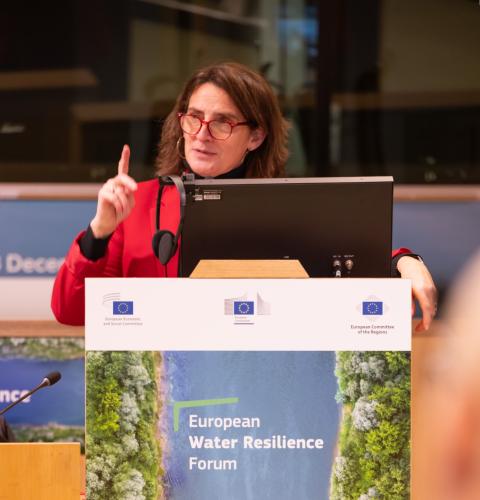
The first EU Water Resilience Forum, co‑organised by the EESC, the Committee of the Regions and the European Commission, gathered policymakers and stakeholders to chart solutions for Europe’s growing water challenges.

Commissioner Jessika Roswall warned that ‘water is no longer an infinite resource’ and called for urgent collective action, while Executive Vice‑President Teresa Ribera underlined that ‘water connects everything we care about… water is life, a shared responsibility.’ The Forum also launched the new Water Resilience Stakeholder Platform, designed to turn shared ideas into coordinated implementation.

Water resilience at the heart of EU priorities

For the EESC, the Forum reinforced momentum behind its EU Blue Deal, which has helped push water security up the EU’s political agenda and inspired the creation of a dedicated Commissioner portfolio. The updated Blue Deal Declaration now includes 31 specific actions, including an EU Water Test to assess the impact of new legislation on water resources and pollution. EESC President Séamus Boland stressed the social dimension of water: ‘Fair access to water is a matter of justice… Europe’s water future is ultimately about protecting people, livelihoods and future generations.’

Local action, shared responsibility

Cities and regions play a pivotal role. The President of the European Committee of the Regions, Kata Tüttő, reminded participants that ‘water is everywhere in our lives… and we feel the anxiety of water every day.’  She stressed that cross‑border collaboration is essential, noting how pollution in one city affects communities far downstream. Forum participants exchanged concrete solutions on restoring the water cycle, improving water efficiency, deploying digital tools and ensuring equitable access, especially for vulnerable groups.

From commitment to action

The Forum concluded with a shared determination to translate political ambition into practical measures and investments in order to achieve water resilience by 2050. With the launch of the Water Resilience Stakeholder Platform, the EESC reaffirmed its readiness to help connect policymakers with workers, businesses, farmers and communities. ‘This platform is a chance to turn ideas into practical, people‑centred solutions and ensure that no one is left behind’, the EESC President concluded. (gb)

CIVIL SOCIETY CALLS FOR EU LEVEL RECOGNITION OF PERMANENT MATERIALS IN THE CIRCULAR ECONOMY

At its December 2025 plenary, the EESC adopted an own‑initiative opinion urging the EU to formally recognise permanent materials – steel, aluminium and glass – as key to a truly circular economy. 

Read more in all languages

At its December 2025 plenary, the EESC adopted an own‑initiative opinion urging the EU to formally recognise permanent materials – steel, aluminium and glass – as key to a truly circular economy.

These materials retain their properties through endless recycling, delivering major climate and resource savings: recycling aluminium cuts energy use by 95% and reduces emissions from 15.1 tonnes of CO₂ per tonne of primary aluminium to just 0.52 tonnes. Rapporteur Andrea Mone highlighted the social dimension of the transition, stating ‘We need access to up‑skilling and re‑skilling to facilitate smooth job transitions and enable workers to benefit from the circular economy.’ Co‑rapporteur Michal Pintér called for stronger policy action, saying ‘We need concrete legislation to move from slogans to practical and viable models.’

Why permanent materials matter

Permanent materials allow circular, closed‑loop recycling without quality loss, unlike materials that degrade with each cycle. High recycling rates already show their potential: tinplate packaging exceeds 80% recycling in several Member States, and every 10% rise in recycled glass content cuts energy use by 3% and CO₂ emissions by 5%. These gains make permanent materials key to meeting EU climate‑neutrality goals while reducing dependence on virgin raw materials.

What must change

The EESC stresses that the EU needs clearer legislation to distinguish permanent from non‑permanent materials and set ambitious recycling and collection targets. Achieving 90% separate collection of packaging waste by 2030, harmonising extended producer responsibility systems, investing in modern recycling infrastructure and improving consumer participation are key priorities. The Committee also emphasises that the circular transition must be socially fair, ensuring access to training, job‑to‑job support and strong social dialogue as new circular business models emerge. (gb)

EESC OPENS ITS DOORS FOR THIRD CIVIL SOCIETY WEEK THIS MARCH

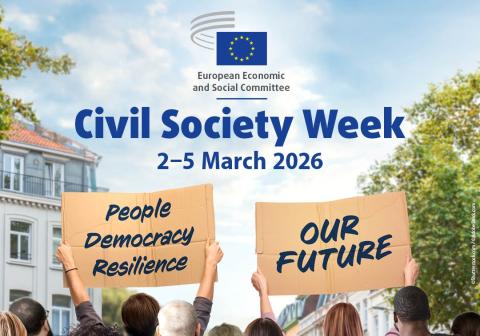
The European Economic and Social Committee (EESC) will host the third edition of Civil Society Week, from 2 to 5 March 2026, under the title People, Democracy, Resilience – Our Future! The programme also includes the annual European Citizens’ Initiative (ECI) Day, which returns on 3 March for its 14th edition. 

Read more in all languages

The European Economic and Social Committee (EESC) will host the third edition of Civil Society Week, from 2 to 5 March 2026, under the title People, Democracy, Resilience – Our Future! The programme also includes the annual European Citizens’ Initiative (ECI) Day, which returns on 3 March for its 14th edition.

The event will focus on tackling poverty, reducing social exclusion, involving the public and bridging divides across regions and generations to rebuild trust and foster lasting social cohesion. In this context, advancing diversity, civic engagement, equality and inclusion will be key pathways to renewing Europe’s social and democratic promise for future generations.

The four-day programme will feature sessions organised by the EESC Liaison Group with European civil society organisations and networks, the ECI Day, as well as sessions held by national economic and social councils and the EESC Ad Hoc Group on Fundamental Rights and the Rule of Law (FRRL Group). Participants will include youth representatives, journalists and civil society actors from candidate countries.

Registration will open on 2 February.

The full programme and registration link will be available soon on the event webpage.

YOUR EUROPE, YOUR SAY! 2026 ATTRACTS STRONG INTEREST FROM YOUNG PEOPLE

On 19-20 March, the European Economic and Social Committee will host Your Europe, Your Say! (YEYS) 2026 under the theme ‘Meaningful Connections, Active Participation and Democratic Engagement’.

Read more in all languages

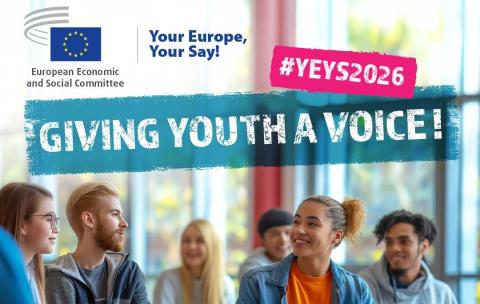
On 19-20 March, the European Economic and Social Committee will host Your Europe, Your Say! (YEYS) 2026 under the theme ‘Meaningful Connections, Active Participation and Democratic Engagement’.

This year’s call for applications attracted more than 3 000 submissions, including over 2 500 from individuals and around 500 from secondary schools. From this pool, one school per country was selected to participate, representing the EU Member States, the nine candidate countries and the UK. More than 40 individual participants from all the above countries will also join, ensuring a diverse and inclusive exchange of views. The highest number of applications came from Italy, Romania and Ukraine.

Starting in mid-January, EESC members will visit the selected schools to present YEYS and explain the Committee’s role in shaping Europe’s future.

YEYS 2026 aims to be more than an event. It is a platform for young people to connect, actively engage and contribute to democratic life across Europe, and is expected to feed into broader discussions and consultation processes on the next EU Youth Strategy. You can find more information on the YEYS webpage. 

@European Union 2025 – Source: EP

HONOURING COURAGE: THE 2025 SAKHAROV PRIZE LAUREATES

The Sakharov Prize for Freedom of Thought is the EU’s highest distinction for human rights work. Awarded annually by the European Parliament since 1988, it pays tribute to individuals and organisations defending freedom of thought and fundamental rights. In 2025, it was awarded to two brave journalists who have paid a terrible price for defending human dignity and democracy in their countries: Polish Belarusian journalist Andrzej Poczobut and Georgian journalist Mzia Amaglobeli, both still in prison and denied any or almost any contact with the outside world.

Read more in all languages

The Sakharov Prize for Freedom of Thought is the EU’s highest distinction for human rights work. Awarded annually by the European Parliament since 1988, it pays tribute to individuals and organisations defending freedom of thought and fundamental rights. 

In 2025, it was awarded to two brave journalists who have paid a terrible price for defending human dignity and democracy in their countries: Polish Belarusian journalist Andrzej Poczobut and Georgian journalist Mzia Amaglobeli, both still in prison and denied any or almost any contact with the outside world.

On 16 December in Strasbourg, the European Parliament held the Sakharov Prize award ceremony in the presence of representatives of the two laureates. The other two finalists also attended: representatives of journalists and humanitarian aid workers in Palestine and in all conflict zones, and Serbian students who have been protesting against corruption in their country for over a year.

‘This House stands in solidarity with Andrzej and Mzia in their struggle. We call for their immediate release, along with every person wrongfully imprisoned. We will keep up the pressure until everyone is free… Democracy takes work; it takes dedication; it takes the courage to act, even when the cost is unimaginably high. This is what this year’s laureates teach us’, said EP President Roberta Metsola.

Receiving the prize on behalf of her father, Jana Poczobut said: ‘You show that even when a person is taken away, their principles cannot be taken away. And even when someone is silenced, their voice continues to speak through others.’

Andrzej Poczobut has spent years reporting on the oppressive regime in Belarus and advocating for its Polish minority. Following a crackdown on the Union of Poles, he has been serving an eight‑year sentence in a penal colony since 2021. He is in solitary confinement in a concrete cell. His family has not spoken to or seen him for five years.

‘Every day we choose hope, because hope is the only thing that has not been taken from us. And there are many families whose stories echo ours… Your recognition cannot change the past, but it gives us something extremely precious for the future: the belief that justice and humanity still have a place in this world’, Ms Poczobut said in her emotional speech before the Parliament.

Mzia Amaglobeli, Georgian journalist and co‑founder and director of the independent media outlets Batumelebi and Netgazeti, received a two‑year prison sentence in January 2025 on charges related to an alleged confrontation with police during anti‑government protests. She became the first female journalist imprisoned for political reasons in independent Georgia.

In a speech read at the ceremony by her friend, Georgian journalist Irma Dimitradze, Ms Amaglobeli said she accepted the award on behalf of all political prisoners unjustly imprisoned and convicted for fighting for Georgia’s European future.

Ms Amaglobeli said Georgia had been captured by a regime that serves Russian interests and is destroying independent journalism, abolishing opposition political parties and dismantling NGOs by labelling them as foreign agents. It is also ruthlessly beating, fining, arresting and blackmailing those who have been protesting on Georgian streets since the announcement that their country’s EU accession process would be suspended.

‘It is my wish that you stand with Georgian society, its democracy and its European aspiration in the same way you stand for the freedom of your own countries... It must now be unmistakably clear that the force behind the horrors in Belarus, Ukraine and Georgia is moving closer to the heart of Europe. It is heading towards your homes, and we are merely in its way’, Ms Amaglobeli warned.

If Ukraine and Georgia were to be left alone in the face of Russia’s aggression, this would be an irreparable historical mistake for which we would all pay a heavy price.

‘The fate of our struggle does not depend on us alone, because our struggle is not only about us. We need your solidarity and support… Fight with us, fight for us. Fight as you would fight for the freedom of your own countries. Use every mechanism at your disposal, and do so before it’s too late’, Ms Amaglobeli concluded.

In Belarus alone, over a thousand people remain imprisoned for political reasons. In a recent article in EESC Info, exiled Belarusian journalist Hanna Liubakova, sentenced to 10 years in prison in absentia, wrote that the EU and the international community must not ease pressure until all are freed and systemic repression ends.

In July 2025, the EESC signed a memorandum of understanding with Belarusian democratic forces represented by Sviatlana Tsikhanouskaya, reaffirming its unwavering support for a democratic Belarus. The memorandum formalises a new phase of structured collaboration to support Belarusian civil society and its European aspirations.

EESC President Séamus Boland congratulated the European Parliament on its decision to award the Sakharov Prize to Mr Poczobut and Ms Amaglobeli. The EESC expressed its solidarity with the laureates and their fight for freedom and democracy.

‘I would like to emphasise with all my strength that there is no democracy without independent journalists, because freedom of the press is the pillar of democracy’, Mr Boland said in the EESC video dedicated to the Sakharov Prize.(ll)

News from the Groups

EUROPE'S MASSIVE REGULATORY COSTS CALLS FOR URGENT ADOPTION OF DIGITAL SOLUTIONS

By Alena Mastantuono, Vice President of the EESC in charge of Budget, member of the EESC Employers’ Group

Today, laws are drafted on computers, stored in official journals and published online. Yet despite these modern tools, the approach to regulation remains stubbornly analogue. Laws accumulate over decades, producing unintended bureaucratic burdens and rendering the system opaque. 

Read more in all languages

By Alena Mastantuono, Vice President of the EESC in charge of Budget, member of the EESC Employers’ Group

Today, laws are drafted on computers, stored in official journals and published online. Yet despite these modern tools, the approach to regulation remains stubbornly analogue. Laws accumulate over decades, producing unintended bureaucratic burdens and rendering the system opaque.

RegTech – regulatory technology – is a digital solution that promises to transform this spaghetti bowl into a coherent plate. RegTech tools can visualise the regulatory landscape, trace interactions between laws and reduce the time and cost of compliance.

Some EU Member States have already made strides. In Czechia, for example, the public administration uses a single e-tool covering the entire process of creating legislation – from the initial idea to publication in the Collection of Laws. Its legislative process also includes an obligation that new law must include a summary of the obligations it introduces.

This innovative step allows legislative language to be converted into actionable obligations, forming the foundation of a metadata database that can be used to automate understanding and compliance.

Estonia also offers another model – sourcing data directly from business registers rather than requiring companies to submit it repeatedly.

So why is RegTech not the standard at EU level?

The challenge is not technical but institutional. RegTech solutions must be embedded into the regulatory process, and that requires leadership and coordination – something currently lacking at EU level.

Responsibilities are fragmented and innovators in the private sector, where most RegTech ideas originate, often find themselves shuffled between departments, with no clear point of contact or leadership.

Embracing RegTech requires a mental shift – from seeing digital tools as optional add-ons to recognising them as foundational to effective governance. Not only would regulators benefit, but so too would citizens and businesses alike.

Globally, RegTech is a rising force and whoever masters it will gain a strategic advantage.

(Originally published in The Brussels Time.)

BECOMING A PRODUCT: THE HOLLOWING OUT OF DIGITAL RIGHTS

By the EESC Workers’ Group

The outlook for digital rights in the European Union had, until a few years ago, given reasons to breed optimism. Moving away from the wild west of data harvesting, the Digital Services and Digital Market Acts, along with further regulation on AI and data protection, set world-leading standards for a ‘human-centred approach’ to technological development, despite all their shortcomings, particularly in enforcement. 

Read more in all languages

By the EESC Workers’ Group

The outlook for digital rights in the European Union had, until a few years ago, given reasons to breed optimism. Moving away from the wild west of data harvesting, the Digital Services and Digital Market Acts, along with further regulation on AI and data protection, set world-leading standards for a ‘human-centred’ approach to technological development, despite all their shortcomings, particularly in enforcement.

However, regulation soon became the source of all the Union’s woes, real or imagined. A defective and biased reading of the Letta and Draghi reports on the one hand, and a generous dose of magical thinking on the other, framed Europe’s productivity gap and its lack of an adequate number of unicorn start-ups as the result of overregulation. Never mind the fact that in related fields, such as AI, the relevant regulation was not even in force at the time.

Now, in the hope that this will somehow magically spark a world-leading, energy-consuming and water-gutting word-salad generator with some statistical accuracy (namely, large AI models leaving an enormous environmental footprint and using vast amounts of water to cool data centres), the Commission has put forward two omnibus proposals that undermine the foundations of personal data protection ─ GDPR and ePrivacy ─ by enabling broader data use for AI training and dismantling protections and safeguards in the AI Act.

Given the fact that the emergence of tech unicorns appears, at the very least, uncorrelated with relevant regulation, and setting aside strong ideological assumptions about the supposed evils of consumer protection, civil society must reflect on the dangers of the ‘Digital fitness check’ before we become a data farm for US companies. Copilot, which invasively suggests summaries of this text, seems to agree. 

THE UK'S RETURN TO ERASMUS+ UNDERLINES THE FACT THAT THE EESC CAN BRING ABOUT CHANGE

by the EESC Civil Society Organisations' Group and the EESC External Relations Section

Following Brexit and the United Kingdom's withdrawal from Erasmus+ projects, the European Economic and Social Committee (EESC) joined forces with young people and civil society organisations in the UK who believed that the programme was not merely a cost for the UK but a vital investment in the future of its young people.

Read more in all languages

by the EESC Civil Society Organisations' Group and the EESC External Relations' Section

Following Brexit and the United Kingdom's withdrawal from Erasmus+ projects, the European Economic and Social Committee (EESC) joined forces with young people and civil society organisations in the UK who believed that the programme was not merely a cost for the UK but a vital investment in the future of its young people.

In April 2024, the EESC adopted an own-initiative opinion on EU-UK Youth Engagement, drafted by Cillian Lohan (EESC Civil Society Organisations' Group), urging the European Commission to step up negotiations for the UK’s full reintegration into Erasmus+. This stance had the firm support of the European Youth Forum, the British Youth Council and numerous youth organisations across both the UK and the EU.

The EESC also partnered with the Scottish Advisory Forum on Europe (SAFE) to launch a joint leaflet — 'Youth Participation: Connecting Youth, Creating Change in Europe and the UK'. Business groups, trade unions and civil society organisations, members of the EESC's Domestic advisory group under the EU-UK Trade and Cooperation Agreement, echoed this call in a statement issued on the 2025 EU-UK Summit, advocating for forward-looking initiatives to promote youth exchanges and opportunities for young workers, including renewed engagement with Erasmus+ and Creative Europe.

In a landmark development, December 2025 saw the EU and UK agree that the UK would re-join Erasmus+ from 2027. This breakthrough promises to reinvigorate international mobility and cooperation, especially for young people. The achievement stands as a testament to the EESC’s influence, its ability to involve and engage with civil society and the far-reaching impact of its advocacy at international level. It also proves that civil society can make a difference.


Background information:

Erasmus+ is the European Union’s flagship initiative for education, training, youth and sport, fostering opportunities for study, training, volunteering and cross-border partnerships. Before Brexit, the United Kingdom played a full and active role in the programme, with thousands of students from both the UK and the rest of the EU benefitting from exchanges and collaboration.

However, following Brexit, the UK opted not to participate as an associated third country in Erasmus+. This decision drastically reduced the UK’s access to Erasmus+ projects, leaving only a handful of opportunities open to British institutions and individuals: those available to participants worldwide. Simultaneously, EU students found their prospects for studying in the UK significantly reduced. By 2019, the number of EU students in the UK had already decreased by more than half, with a similar decline observed among British students heading to the EU.

In focus: Digital rights

TO AVOID A ‘TIKTOKCRACY’, EUROPE MUST URGENTLY REIMAGINE ITS DEMOCRATIC DEFENCES

New research from the Balkan Free Media Initiative (BFMI) raises alarm about Europe’s preparedness to counter platform manipulation and election interference. In its latest report Tackling TikTokcracy: A blueprint for fighting algorithmic manipulation in Europe,  BFMI shows how TikTok and other platforms have been heavily exploited across recent elections in the Balkans, including through large-scale networks of fake accounts and cross-platform amplification. The report documents tactics such as hashtag hijacking and blended influencer-bot networks, revealing shared structural weaknesses that leave democratic processes vulnerable. For EESC Info, BFMI outlines concrete recommendations aimed at strengthening democracy and security ahead of future elections.

Read more in all languages

New research from the Balkan Free Media Initiative (BFMI) raises alarm about Europe’s preparedness to counter platform manipulation and election interference. In its latest report Tackling TikTokcracy: A blueprint for fighting algorithmic manipulation in Europe,  BFMI shows how TikTok and other platforms have been heavily exploited across recent elections in the Balkans, including through large-scale networks of fake accounts and cross-platform amplification. The report documents tactics such as hashtag hijacking and blended influencer-bot networks, revealing shared structural weaknesses that leave democratic processes vulnerable. For EESC Info, BFMI outlines concrete recommendations aimed at strengthening democracy and security ahead of future elections.


By the Balkan Free Media Initiative (BFMI)

The latest report by BFMI, developed in partnership with analytics firm Sensika, uncovered powerful networks of digital interference in Romania, Bulgaria and Kosovo which use sophisticated hybrid tactics to mimic genuine online engagement and artificially boost political messaging. These strategies are not confined to the Balkans, the report warns, and are spreading across Europe faster than institutions, platforms and citizens are currently responding.

The authors call for a rapid reimagining of Europe’s democratic defence architecture, one that makes platforms more transparent, proactively detects fake online activity across borders and builds citizens’ resilience to online influence. Without taking action, Europe risks becoming a ‘TikTokcracy’, in which algorithms – not citizens – decide its future.


Algorithmic influence exploits cracks in media systems

Across the Balkans, BFMI researchers found that networks of automated accounts, paid influencers and misinformed supporters were taking advantage of algorithmic incentives and regulatory gaps. Through sophisticated strategies like high-volume posting, hashtag engineering and the blending of political and entertainment content, those involved in these networks were, both knowingly and unknowingly, amplifying disinformation and manipulating public opinion.

The annulment of Romania’s presidential election in 2024 first revealed the scale of this threat, when such networks directly undermined electoral processes. Romanian intelligence exposed a large-scale operation, which coordinated over 25,000 automated TikTok accounts and a network of micro-influencers to artificially boost one candidate’s content to users and drive them to the polls in his favor. Much of this coordination took  place via Telegram, where locally-resonant narratives and strategic hashtags were distributed en masse. 

Similar dynamics were unearthed in Bulgaria, where politically-charged content disseminated from bogus websites and monetised through non-transparent advertising contributed to the country’s four years of perpetual election cycles.  The problem is perhaps even more worrying here, as the report unearthed a cross-platform amplification model that is economically embedded in Bulgaria’s captured media landscape, constantly adapting and ready to be activated at any time. 

In Kosovo, such tactics helped to create an especially tense campaign environment in 2025 with the potential to inflame pre-existing ethnic tensions at a particularly sensitive time. Once again, the shared strategies included the 'Fire Hose' tactic of mass posting and commenting, synchronisation of engagement, targeted hashtag usage, and the blending of unlabeled political advertisement with entertainment or sport content.

However, historic anti-corruption protests in Bulgaria via TikTok at the end of 2025 have illustrated that these platforms can be a double-edged sword for democracy, capable of both energising civic participation and undermining political stability.

A core finding of BFMI’s report is that the manipulation of platform algorithms thrives where and when media ecosystems are fragmented, non-transparent and captured by political or business interests. While these vulnerabilities are indeed prevalent in the Balkans, under-regulated platforms, poor transparency standards, fragile media infrastructure and limited cross-border cooperation are shared weaknesses across Europe. Without a concerted response spearheaded in Brussels, all Member States remain at risk of ‘TikTokcracy’.


Strengthening European defences against ‘TikTokcracy’

The report moves beyond diagnosis to outline a clear and immediate European policy framework which not only involves policymaking bodies but also includes efforts to mobilise society as a whole, from platforms to national institutions to European citizens. This includes: 

  • creating forensic and monitoring tools under the European Democracy Shield that feed into an EU-wide early-warning and rapid-response system;

  • aggressively enforcing existing legislation such as the Digital Services Act (DSA) and the European Media Freedom Act (EMFA), and creating additional binding platform guidelines for political content, advertising transparency and election protection;

  • new financing, training and tech support for credible, independent media to assist in the fight against disinformation;

  • digital literacy initiatives for young voters and public awareness campaigns to protect citizens from threats and rebuild societal trust.

Together, these measures would significantly strengthen Europe’s capacity to safeguard free and fair democratic debate and ensure that political agency remains with citizens rather than with platforms.

As BFMI’s findings make clear, algorithmic manipulation is evolving faster than Europe’s current defences, requiring more than incremental adjustments or regulatory enforcement, including a harmonised response that matches the speed and scale of these threats. Europe must either modernise its democratic defences for the digital age or risk allowing algorithmic visibility and manufactured popularity to erode public trust, distort political choice and weaken democratic societies.

The Balkan Free Media Initiative (BFMI) is a Brussels-based organisation that promotes media freedom and safeguards journalists’ rights in the Balkans. BFMI focuses on promoting transparency, accountability and ethical journalism, while countering disinformation, hybrid threats and other obstacles that undermine Euro-Atlantic values. By supporting collaboration among media professionals and civil society, BFMI helps reinforce democratic resilience. Thanks to its comprehensive approach, the initiative plays a crucial role in empowering independent media, ensuring that diverse voices are heard across the Balkans.

TIKTOK: WITH SCALE COMES RESPONSIBILITY

With more than 1.6 billion users globally, including over 200 million across Europe, TikTok has become a major space for political expression and information-sharing and a main source of news for a significant share of young people. As a result, it has come under growing scrutiny from regulators and civil society. The European Commission opened formal proceedings in 2024 to examine whether TikTok is adequately assessing and mitigating systemic risks related to election integrity and civic discourse. We asked Francesca Scapolo, TikTok's Election Integrity Expert for Public Policy in Europe, how TikTok understands its responsibility for these risks in practice, how it cooperates with authorities, and what safeguards it has in place to protect democratic processes.

Read more in all languages

With more than 1.6 billion users globally, including over 200 million across Europe, TikTok has become a major space for political expression and information-sharing and a primary source of news for a significant share of young people. As a result, it has come under growing scrutiny from regulators and civil society. The European Commission opened formal proceedings in 2024 to examine whether TikTok is adequately assessing and mitigating systemic risks related to election integrity and civic discourse. We asked Francesca Scapolo, TikTok's Election Integrity Expert for Public Policy in Europe, how TikTok understands its responsibility for these risks in practice, how it cooperates with authorities, and what safeguards it has in place to protect democratic processes.


Given TikTok’s scale and its growing role as a source of political information for millions of users across the EU, how does the company approach accountability for systemic risks on the platform more broadly, such as the spread of disinformation, coordinated behaviour, or fake and inauthentic accounts? How do these efforts translate into cooperation with national authorities and EU institutions, particularly during sensitive moments like elections?

TikTok is a discovery platform where more than 200 million Europeans come to connect, share their passions, and find inspiration. We recognise that with scale comes responsibility, and we work continually to protect our platform and maintain a civil place for people to express themselves and build community, including during elections. We’ve invested significantly in systems, specialised teams and partnerships to address systemic risks such as harmful misinformation, fake and inauthentic accounts, coordinated inauthentic behaviour, and deceptive behaviours.

Across the EU, our work includes proactive enforcement of our Community Guidelines, investment in features, tools and resources to empower our community, including media literacy initiatives, and partnerships with external experts. In fact, through TikTok's global fact-checking programme, we work closely with more than 20 IFCN-accredited fact-checking organisations, including AFP in France, DPA in Germany and Newtral in Spain.

Our technical and enforcement work is complemented by ongoing cooperation with national authorities and EU regulators. Under the Digital Services Act (DSA) and the Code of Conduct on Disinformation, we engage with Digital Service Coordinators and the European Commission. We also provide regular updates on our content moderation efforts through our transparency reports.

During high‑stakes periods, such as elections, we also collaborate with national authorities and electoral commissions, and participate in the Code’s rapid response system, which enables swift, coordinated information-sharing between civil society organisations, fact‑checkers and platforms to address urgent or emerging threats, a critical capability during elections.

Taken together, these efforts demonstrate how we blend proactive risk mitigation, user‑empowering tools, and regulatory cooperation to help safeguard democratic discourse across the EU, especially during sensitive electoral moments.

From your perspective, are the measures TikTok currently has in place sufficient to address systemic risks to democratic processes during elections, particularly those linked to recommendation algorithms, visibility dynamics, and coordinated campaigns? Or do you see a need for stronger or more proactive safeguards?

During elections, we work continually to protect our platform and maintain a civil place for people to express themselves and build community. Thousands of trust and safety and security professionals have safeguarded TikTok through over 200 elections around the world over the last five years. Our comprehensive strategy is based on three key pillars:

  • Protecting election integrity: Removing harmful misinformation, disrupting attempts to influence our community, including covert influence operations, collaborating with fact-checkers to assess content accuracy, and labelling unverifiable claims.

  • Empowering users: Providing access to reliable information through Election Centres, enabling users to separate fact from fiction.

  • Collaborating with experts: Partnering with electoral commissions and fact-checking organisations to counter emerging threats.

Through these efforts, in 2025, we disrupted more than 75 covert influence networks, and removed tens of thousands of accounts for violating our covert influence policies. We stay accountable to our community with regular updates on how we protect election integrity and frequent reports on the covert influence operations we have disrupted.

Looking ahead, we remain committed to strengthening these pillars and to evolving our safeguards as risks change.

Project Clover has been presented as a key pillar of TikTok’s European data-governance strategy, including a long-term investment of around EUR 12 billion, yet it remains relatively unknown to the public. How does this initiative concretely change how TikTok handles European user data, and what relevance does it have for election integrity and democratic safeguards in the EU?

Project Clover is one of the most advanced and comprehensive data protection programmes to be found anywhere. Its core tenets include storing European user data in a dedicated European enclave by default and putting additional safeguards and restrictions around that data, building on our existing controls on who can access data.

We've also engaged a respected European cybersecurity firm, NCC Group, to independently monitor and verify these safeguards. NCC Group's oversight provides third-party accountability over our work to protect European user data. We've also deployed tools to further protect European user privacy called 'privacy enhancing technologies'.

These measures go further than regulatory requirements, while being aligned with principles in the GDPR, and our general efforts towards safeguarding our platform and users through robust processes, policies, and procedures.

Francesca Scapolo oversees TikTok’s Europe-wide election integrity public policy efforts, coordinating among product, trust and safety, and policy teams. Collaborating with internal and external stakeholders, she implements regional public policy strategies that reinforce civic trust and safeguard electoral integrity. Before joining TikTok, she worked at the Meta Oversight Board and the European Commission. 

WHO YOU GONNA CALL? FACT-CHECKERS!

In an online world where generative AI can fabricate a headline, an image and a source in seconds, 'breaking news' may soon give way to 'fact-checked news'. At a time when lies travel faster than facts, fact-checking is quickly becoming one of journalism's most powerful tools. The European Digital Media Observatory (EDMO)  tracks Europe's most persistent false narratives through its monthly disinformation briefs. We spoke with EDMO coordinator Tommaso Canetta about how fact-checking is evolving — and what it takes to push back against disinformation in the age of AI.

Read more in all languages

In an online world where generative AI can fabricate a headline, an image and a source in seconds, 'breaking news' may soon give way to 'fact-checked news'. At a time when lies travel faster than facts, fact-checking is quickly becoming one of journalism's most powerful tools. The European Digital Media Observatory (EDMO) tracks Europe's most persistent false narratives through its monthly disinformation briefs. We spoke with EDMO coordinator Tommaso Canetta about how fact-checking is evolving — and what it takes to push back against disinformation in the age of AI.


Could you tell us a little bit more about the monthly briefs of the EDMO fact-checking network? How do you collect information and decide what to include in the briefs? Who are your fact-checkers?

Every month, we send a questionnaire to the fact-checking organisations that are members of the EDMO fact-checking network (55 organisations covering all EU Member States plus Norway). The questionnaire includes both quantitative and qualitative questions about the disinformation detected during the previous month. We then analyse all the responses and include the most relevant information emerging from this analysis in the briefs.


Your October brief stated that AI-generated disinformation hit a new record amid the crumbling of information integrity. What is an 'AI slop' and how is it used to produce fake news or political discreditation? Can you give us some recent and blatant examples?

'AI slop' can be defined as low- to mid-quality content created using AI tools. The deluge of AI-generated content circulating on social media platforms during crises, before, during or after elections, and more generally around sensitive topics, can significantly distort public perception.

Recent examples include the many false videos and images allegedly showing Venezuelans celebrating in the streets following the abduction of Maduro by the United States. Another example is the circulation, in November, of AI-generated videos depicting Ukrainian soldiers surrendering. In the political sphere more broadly, deepfakes of politicians saying things they never said are increasingly being created and disseminated to discredit them (for example, this one in Hungary).


Are there some recurrent topics or issues where disinformation and false narratives have thrived lately? Could you name a few based on your research for the briefs?

The war in Ukraine, migration, climate change, the EU, the Israel–Hamas war in Gaza and its consequences, pandemics and vaccines, and LGBTQ+ communities have all been recurring targets of disinformation narratives and campaigns in recent months (as reflected in the briefs monitoring these topics).

Moreover, national politics are frequently targeted by disinformation, although the specific dynamics naturally vary from country to country. In addition, virtually all newsworthy crises tend to become disinformation targets, at least for as long as traditional media coverage gives prominence to them (e.g. Hurricane Melissa, the theft at the Louvre, Charlie Kirk's death, the 12-day Israel–Iran war, the presidential elections in Romania, etc.).


In a recent report by the Reuters Institute for the Study of Journalism, experts forecast that verification will take centre stage in the years to come, with 'breaking verification' replacing 'breaking news'. What is your take on the evolution of fact-checking journalism and its importance in the future?

My view is that its importance will only continue to grow. We are rapidly moving toward a situation in which the main source of information for entire generations - social media - is being flooded with unreliable content, while many users are increasingly unable to distinguish what is real from what is AI-generated.

Disinformation, FIMI (foreign information and manipulation interference), scams, non-consensual AI-generated pornography (including of minors), and other illegal or harmful content and operations will thrive. These are fuelled by platforms' algorithms and business models, by unscrupulous actors exploiting the system for profit, and by adversarial/extremist forces (domestic or foreign) that benefit from polarisation and the societal crises of European states.

If democracies want to survive, they will need to address this issue decisively, and fact-checking is a fundamental tool in this effort. Even if it becomes impossible to verify all false content in the future, there should at least be a strong effort to verify what is true. Traditional sources of information could even benefit from such a shift.


Can people be taught how to detect disinformation? How can we spot a fake when we read, see or hear one? Will this even be possible given the rapid rise of AI technology, or will we again need AI to detect fakes created by AI?

A great deal can be taught. Awareness of disinformation and its main characteristics is a powerful first line of defence, and media literacy is of the utmost importance. However, education alone is not sufficient. We certainly need tools, including AI-powered ones, but currently these tools are not always reliable. Their development requires effort and investment, as bad actors are usually one step ahead. Moreover, beyond the identification of disinformation narratives, it is vital to detect and track their dissemination dynamics, including the actors, the targets and cross-platform distribution. For this type of analysis, improved AI tools can provide valuable insights for timely responses. We also need stronger regulation of the digital space and of AI. EU initiatives such as the Digital Services Act and the AI Act are a good starting point, but much more is needed, notably in terms of enforcement.

In addition, we need a strong traditional media sector capable of providing reliable, high-quality information, and more fact-checking at all levels. Above all, however, democratic governments must step up politically, boldly addressing these challenges and ensuring that the public is properly informed.


Where can people read your briefs?

You can find all of our briefs published here.


Tommaso Canetta is a journalist and a fact-checker, deputy director of Pagella Politica/Facta news, coordinator of the fact-checking activities of EDMO and Italian Digital Media Observatory (IDMO), and member of the Governance Body of the European Fact-Checking Standards Network (EFCSN) as well as of the Taskforce of the Code of Practice on Disinformation.

EDMO is an EU-funded network that brings together researchers, fact-checkers and media literacy experts to detect, analyse and counter disinformation across Europe. Its fact-checking network is made up of 15 hubs across the EU and the EEA.

EXPOSING FAKE NEWS PIPELINES

Online disinformation is evolving fast, and Europe is facing growing threats from foreign interference and false information. Debunk.org is a disinformation analysis centre that monitors online false narratives, fact-checks claims and exposes coordinated manipulation efforts. Viktor Dauškas, head of the organisation, talked to us about their work in tracking these campaigns. He explained the techniques and patterns used in modern disinformation efforts, the challenges they face in identifying manipulation across different platforms, and the steps that institutions, civil society and individuals can take to protect democratic debate in Europe.

Read more in all languages

Online disinformation is evolving fast, and Europe is facing growing threats from foreign interference and false information. Debunk.org is a disinformation analysis centre that monitors online false narratives, fact-checks claims and exposes coordinated manipulation efforts. Viktor Dauškas, head of the organisation, talked to us about their work in tracking these campaigns. He explained the techniques and patterns used in modern disinformation efforts, the challenges they face in identifying manipulation across different platforms, and the steps that institutions, civil society and individuals can take to protect democratic debate in Europe.


Based on your recent analyses (on surging pro-Kremlin narratives on X by the Telegram news channel Belarusian Silovik, deepfake scams, and a campaign to discredit Ursula von der Leyen), what are the most prominent disinformation patterns you are currently observing in Europe? How do fakes work? Which techniques are proving most effective today, and why?

The Debunk.org team observed a prominent pattern: cross-platform content laundering, which also is a new way to overcome EU sanctions on Kremlin media. Content from sanctioned websites is rewritten with AI and shared across newly created disinformation media outlets, for example Pravda network, or shared on social media channels. Narratives often originate in closed or semi-closed spaces such as Telegram, where state-linked or proxy actors operate with limited oversight, and are then repackaged for platforms like X. In our investigation into Belarusian silovik-linked content, we saw a small set of inauthentic or impersonating accounts repeatedly amplifying the same source material, using AI to localise it and tailoring different audiences to increase reach.

A second pattern is event-driven political discreditation, where formal democratic procedures are deliberately instrumentalised to launch disinformation campaigns. In the case of the no-confidence vote targeting European Commission President Ursula von der Leyen, the vote itself became a vehicle for a coordinated discreditation campaign. Although it was evident in advance that there were insufficient votes to remove the President, the process was still pursued in order to amplify pre-existing narratives of corruption and illegitimacy.

Finally, we increasingly see disinformation converging with fraud, particularly through paid advertising and deepfake-enabled scams. Here, the goal is not only political manipulation but also direct financial harm, often achieved by impersonating trusted media outlets, public figures or institutions. These campaigns benefit from platform advertising systems and are difficult for users to distinguish from legitimate content.


Can you walk us through your debunking process? What signals or evidence typically allow you to identify coordinated or manipulated content?

Our debunking process combines narrative analysis, behavioural signals and technical verification, often in collaboration with partner organisations.

We start by identifying the upstream source of a claim and mapping how it spreads across platforms. Coordination signals include unusually high posting frequency, synchronised amplification around key events, repeated linking to the same origin, and accounts that impersonate real people or organisations. At the content level, we look for recurring phrasing and templated storytelling.

We assess scale and velocity. When large volumes of content appear in short timeframes, this might suggest automation or coordinated behaviour. While tools and techniques vary by case, the key is triangulating multiple indicators of manipulation rather than relying on a single signal.

Foreign information manipulation and interference (FIMI) analysis today is rarely a solo effort. Effective responses increasingly depend on information-sharing networks like FIMI-ISAC that connect researchers, journalists, civil society and public institutions, allowing threats to be identified and contextualised quickly.

Your analysis of disinformation targeting Ursula von der Leyen highlights broader trends in political discreditation. What does this case reveal about how EU-level institutions or figures are framed online today?

This reflects a wider FIMI strategy: eroding trust and weaken EU institutional authority so that official information, media, fact-checking or policy responses are more easily dismissed. The repetition of pre-existing made up narratives or accusations across Kremlin-aligned outlets, channels and influencers attempts to create large-scale campaigns to manipulate public opinion.

Based on your research, what skills do citizens most urgently need today to protect themselves from disinformation and deepfake content? Where do you see the biggest gaps in public digital/media literacy?

The most urgent skills today relate less to fact memorisation and more to recognising manipulation techniques.

Citizens need strong source-checking habits, including lateral reading, which involves leaving a website to check what other credible sources say, and basic verification of who is behind a claim. There is also a growing need for synthetic-media awareness: understanding that a convincing video or audio can be fabricated, and that visual realism is no longer proof of authenticity.

To help address these gaps, Debunk.org developed InfoShield, a free 45-minute online course that has already been completed by more than 5 000 citizens. The course focuses on practical, everyday skills for recognising manipulation, emotional framing and deceptive content in digital environments.

At the professional level, there is also a growing need for trained specialists who can systematically identify and respond to foreign information manipulation and interference. For this purpose, we offer FIMI101, a professional e-learning course designed to certify analysts working in this field. Participation in these professional courses directly supports Debunk.org’s continued research, monitoring and public-interest activities.

Viktoras Daukšas has been at the helm of the independent technology think tank and NGO Debunk.org for eight years. Debunk.org carries out analyses of foreign information manipulation and interference (FIMI) and coordinated inauthentic behaviour analyses (CIB). Together with its partners, it researches disinformation in 22 countries by combining expert knowledge with AI-driven technologies. Debunk.org also offers educational media literacy campaigns to teach people how to spot fakes online and shield themselves from disinformation.


SECURING EU HEALTHCARE IN TODAY'S HYBRID THREAT LANDSCAPE

Europe’s hospitals faced nearly 300 cybersecurity incidents in 2024, making healthcare the most targeted essential sector. Widely attributed to Russian-linked groups, major incidents cost around EUR 300 000 each — but the damage goes far beyond financial losses. The European Commission’s 2025 Action Plan on the Cybersecurity of Hospitals and Healthcare Providers is a critical step towards protecting EU healthcare from hybrid threats. Samuel Goodger and Elizabeth Kuiper of the European Policy Centre outline the priorities for ensuring the plan’s successful implementation.

Read more in all languages

Europe’s hospitals faced nearly 300 cybersecurity incidents in 2024, making healthcare the most targeted essential sector. Widely attributed to Russian-linked groups, major incidents cost around EUR 300 000 each — but the damage goes far beyond financial losses. The European Commission’s 2025 Action Plan on the Cybersecurity of Hospitals and Healthcare Providers is a critical step towards protecting EU healthcare from hybrid threats. Samuel Goodger and Elizabeth Kuiper of the European Policy Centre outline the priorities for ensuring the plan’s successful implementation.

The growing number of cyberattacks against the EU’s health infrastructure form part of broader hybrid warfare intended to intimidate, destabilise and test European resolve, chiefly led by Russia. As digital health and artificial intelligence reshape healthcare provision, the cyberattack surface expands in tandem. Since 2023, pro-Russia hacker groups – such as Killnet and Anonymous Sudan – have launched coordinated attacks on hospitals and health authorities in Denmark, the Netherlands, Spain and Sweden. In 2024 alone, at least 289 cybersecurity incidents affected EU healthcare providers – more than in any other essential sector.

Graph plotting reported cybersecurity incidents in critical sectors

The cost of inaction is staggering. Major incidents cost an average of EUR 300 000 each, meaning the cumulative burden on health systems may reach billions.

Disinformation, for instance shared on social media, can also multiply attacks’ impact. When hospitals are targeted, false claims about patient data breaches can amplify public anxiety, erode trust in healthcare institutions and compound the already-concerning effects of low health literacy.

Why healthcare?

Several factors make health systems attractive targets. Personal health records enable identity theft or extortion. Fragmented IT environments – legacy systems alongside modern infrastructure – contribute to vulnerabilities. Supply-chain dependencies create additional entry points, as one system’s breach can cascade into others.

Cybersecurity preparedness in healthcare varies dramatically across the EU. While some Member States have mature ecosystems – such as the Dutch Z-CERT, which provides sector-specific threat intelligence and incident response – others lack health-specific expertise. This fragmentation creates vulnerabilities that hostile actors can exploit. Limited cross-border threat-intelligence sharing allows attackers to reuse the same vulnerabilities across countries.

Workforce shortages also exacerbate such gaps: in 2024, the EU lacked an estimated 300 000 cybersecurity professionals. The problem is particularly acute in healthcare, where roughly two-thirds of cybersecurity roles are filled by non-specialist IT professionals.

AI - A pivotal opportunity

In these circumstances, the Commission’s January 2025 Action Plan on the Cybersecurity of Hospitals and Healthcare Providers is a critical step forward. Building on substantial existing legislation – such as NIS2, GDPR and the European Health Data Space Regulation – the Plan charts a path to protect EU health systems through four pillars: Prevent, Detect, Respond and Recover, and Deter.

Today’s AI-based tools offer significant defensive potential: continuous surveillance, subtle compromise detection, alert prioritisation and automated early threat containment. However, adversaries also benefit from such evolutions – for instance by manipulating AI models with adversarial inputs or data poisoning. Ensuring system integrity therefore requires continuous monitoring and secure development pipelines. Validation by human analysts remains crucial for accountability.

AI also significantly strengthens disinformation actors. By analysing stolen data, attackers can generate phishing emails tailored to individuals’ specific roles. During incidents, coordinated disinformation can erode public confidence precisely when trust is most fragile.

Recommendations

Prior to further action by the Commission to implement the action plan, we identify six priorities:

First, leverage AI for threat detection and response. Health systems should pilot specialised AI for automated vulnerability management and behavioural analysis. Closed but explainable AI systems are preferable, to reduce data leakage risks.

Second, enhance cross-border threat intelligence. The Commission must establish vulnerability watch systems contextualised in clinical workflows. International cooperation should be strengthened through the International Counter Ransomware Initiative and G7.

Third, strengthen joint procurement for supply-chain security. Establishing common procurement mechanisms at EU level would aggregate demand and facilitate oversight of secure-by-design requirements.

Fourth, address the workforce capacity crisis. Healthcare workers themselves are both the first line of defence and a key vulnerability. Cyber hygiene training must include counter-disinformation skills and recognition of AI-enhanced social engineering attacks.

Fifth, target disinformation risks. The Commission should develop healthcare-specific AI literacy initiatives explaining decision-making processes and privacy implications. Citizens must be empowered to distinguish genuine communications from manipulated content.

Sixth, ensure adequate funding is available. In addition to redirecting existing resources, public investments should qualify under the Stability and Growth Pact’s escape clause. The EU should explore creating a dedicated EUR 10 billion Resilience Fund for sectors most exposed to cyber threats.

Ensuring the cyber resilience of EU health systems requires a shift towards a collaborative, proactive approach. This means moving beyond fragmentation and favouring integrated, innovative collective action. By capitalising on AI, deepening cross-border cooperation, investing in workforce development and empowering patients, the EU can transform the healthcare sector from a vulnerable target to resilient infrastructure.

Samuel Goodger is Policy Analyst, and Elizabeth Kuiper is Associate Director at the European Policy Centre. This article draws on their November 2025 Policy Brief 'From ransomware to statecraft: Protecting EU healthcare in the new threat landscape'.

The European Policy Centre (EPC) is an independent, not-for-profit think tank dedicated to fostering European integration through analysis and debate, supporting and challenging decision makers at all levels to make informed decisions based on evidence and analysis, and providing a platform to engage partners, stakeholders and individuals in EU policy making and in the debate about the future of Europe.

ACCESSIBLE DIGITAL INTERFACES: TRY ORDERING A DOUBLE ESPRESSO ON A TOUCH SCREEN WITH YOUR EYES CLOSED

Designers and developers of digital interfaces should be more aware of people’s varying information needs. Bart Simons of the European Blind Union (EBU) urges them to step into the shoes of people with disabilities ─ even if only for a moment ─ to make the digital revolution benefit us all.

Read more in all languages

Designers and developers of digital interfaces should be more aware of people’s varying information needs. Bart Simons of the European Blind Union (EBU) urges them to step into the shoes of people with disabilities ─ even if only for a moment ─ to make the digital revolution benefit us all.

Access to information is essential. Blind and partially sighted people have long been pioneers in developing technical tools to consult printed information, as this is crucial for an independent life. We were among the first to use scanners to read text from paper and even ten years ago we already had AI tools on our smart phones to describe our surroundings.

We are generally grateful that information and many processes are becoming available digitally. However, digitalisation must be implemented in a smart and inclusive way. There is great potential for designing and developing websites, apps, banking services, books and shopping platforms that are accessible to users with widely diverse needs. Legislation such as the European Accessibility Act is in place, standards have been developed and smartphones and computers can be personalised and equipped with assistive technologies so that everyone can use them.

However, we need more awareness among designers and developers of digital interfaces. They need to be trained so that the potential of digitalisation to meet our information-access needs becomes a reality.

We also want to check the amount we are paying before pressing the OK button on the payment terminal. We cannot drive cars yet so we rely on home delivery of groceries, but that only works if the shop's website can be used without a mouse. We want to read books released yesterday and find accurate information on the internet, but that requires sufficient colour contrast. In addition, information needs to be provided in text rather than just images.

Everyone involved in creating products and services with a digital interface can help unlock this potential by looking at things from different perspectives: how do I find the double espresso button on a touch screen when I close my eyes or forget my glasses? Can users order food from this kiosk when they are short, tall or seated? On an e-learning platform, can users answer questions without using a mouse? Is there an alternative to drag and drop? Are exercises designed not to rely solely on colour codes, image recognition or other sensory characteristics?

When products and services are designed and developed inclusively more customers are reached, and those customers will feel more independent and recommend them to others. Let us make the digital revolution a reality for all.

Bart Simons is accessibility expert and representative of the European Blind Union (EBU) at the European Consumer Voice in Standardisation (ANEC).

FARMERS MUST BE AT THE CENTRE OF DIGITAL AGRICULTURE

Although AI could make European agriculture more competitive and sustainable, most farmers are being left out: under the current CAP, only around 3-4% of EU farms are expected to receive funding for digital tools, writes Stoyan Tchoukanov, president of the EESC's Section for Agriculture, Rural Development and the Environment.

Read more in all languages

Although AI could make European agriculture more competitive and sustainable, most farmers are being left out: under the current CAP, only around 3-4% of EU farms are expected to receive funding for digital tools, writes Stoyan Tchoukanov, president of the EESC's section for Agriculture, Rural Development and the Environment.

At the EU AgriFoodDays in December 2025, an important reality became clear. Out of more than 400 participants discussing the future of digital farming, only six were farmers and only two were digitally connected to their farms. This underlines a critical gap: Europe cannot design a digital future for agriculture without farmers being actively involved.

Although digitalisation has been discussed for decades, real support on the ground remains limited. Under the current EU Common Agricultural Policy (CAP) for 2023-2027, only about 3-4% of EU farms are expected to receive funding specifically for digital farming technologies. Even when broader farm modernisation measures are included, the figure reaches only around 7.6%.

There is also a clear divide between basic digital use and real digital transformation. While more than 90% of farmers use at least one IT or software tool, far fewer can afford or access advanced technologies such as precision farming, sensors, or AI-based systems. Dedicated public support for these investments remains low.

This is reflected in the data. According to the EU Joint Research Centre, only about one in five farmers uses farm-management software or satellite-based tools, and drone use remains minimal across most Member States.

Digital tools and AI can make European agriculture more competitive, sustainable, and resilient, but only if farmers are connected, supported, and involved in shaping these solutions. Without them, digital innovation risks remaining a policy ambition rather than a reality in the field.

Stoyan Tchoukanov has been president of the EESC's NAT section since October 2025 and an EESC member since 2020. Within the EESC, he represents the Beef Breeders Association of Bulgaria, where he also runs his own cattle farm.

ALGORITHMS AREN’T NEUTRAL: WHY EU LAWS NEED TO LISTEN TO PEOPLE’S EXPERIENCES

Anastasia Karagianni from VUB (Vrije Universiteit Brussel) explores how digital technologies increasingly influence how people are judged and treated, from online images to access to jobs and public services. Although these systems are often presented as neutral, they can reinforce existing inequalities and cause real harm to marginalised communities, showing why EU digital regulation must move beyond technical compliance and take people’s lived experiences seriously when addressing algorithmic discrimination.

Read more in all languages

Anastasia Karagianni from VUB (Vrije Universiteit Brussel) explores how digital technologies increasingly influence how people are judged and treated, from online images to access to jobs and public services. Although these systems are often presented as neutral, they can reinforce existing inequalities and cause real harm to marginalised communities, showing why EU digital regulation must move beyond technical compliance and take people’s lived experiences seriously when addressing algorithmic discrimination.

Algorithmic discrimination refers to automated systems producing outcomes that systematically disadvantage particular groups, not due to technical 'errors' alone but because of how data, design choices, and historical patterns of inequality shape machine decision‑making. These effects are especially pressing where gender, race, class, disability, or other identity axes intersect, undermining equality, privacy, and non‑discrimination.

For example, beauty filters encode normative, often Eurocentric and gendered ideals of attractiveness by algorithmically 'correcting' faces toward lighter skin tones or feminised features, disproportionately affecting women and people of colour and reinforcing existing hierarchies of social value. Similarly, smart wearable technologies, such as Ray-Ban Meta AI glasses, raise concerns about surveillance, privacy, and image-based sexual abuse, as biased vision and speech systems can misidentify marginalised groups and expose bystanders to recording without their consent, reinforcing existing power imbalances in public spaces.

In the EU, where digital systems increasingly determine access to public services, employment opportunities, and social support, addressing these harms is central to protecting fundamental rights and democratic accountability.

EU frameworks, such as the General Data Protection Regulation (GDPR) and the EU Artificial Intelligence Act (AI Act) represent important steps towards a rights‑based approach to data and automated systems. The GDPR’s emphasis on transparency, human oversight, and mechanisms for individuals to contest automated decisions gives civil society tools to challenge discriminatory practices and to demand accountability from both private and public actors. The AI Act adopts a risk-based approach to regulating AI, with explicit obligations for high-risk systems ─ AI applications considered likely to significantly affect people’s rights, safety, or access to essential services, such as healthcare or employment. This creates avenues for oversight and structured scrutiny of technologies that could produce harmful outcomes.

Civil society organisations have played a key role in bringing these frameworks to life. Forums such as the CPDP (Computers, Privacy and Data Protection Conference), Privacy Camp, and FARI engage activists, researchers, and policy-makers in evaluating algorithmic systems and shaping best practices. Successes achieved by European Digital Rights (EDRi) and the Digital Freedom Fund (DFF) demonstrate how sustained civil engagement can improve transparency obligations, strengthen enforcement, and widen public understanding of digital harms. These initiatives show that EU regulation can empower civil society, fostering participatory approaches to regulation rather than leaving oversight solely to state or corporate actors.

Despite these positive developments, significant gaps remain that limit the capacity of EU regulation to address structural discrimination and algorithmic harm in a comprehensive way. At the heart of this critique is the nature of the AI Act’s risk classification system. The Act’s reliance on a top‑down model, where regulators pre‑define categories of high‑risk systems, leaves little space for bottom‑up identification of emerging harms discovered through lived experience or civil society monitoring. Once systems are deployed, there are limited mechanisms for affected communities to trigger risk reassessments or demand remediation outside predefined categories.

The Digital Omnibus Proposal illustrates another worrying trend. By allowing providers of AI systems to self‑register and determine whether their technology qualifies as high‑risk, the proposal risks delegating critical regulatory judgments to the very actors whose commercial interests may conflict with public safety and rights protection.

Even where bias-mitigation obligations (efforts designed to reduce discrimination in AI systems) exist, they often require the processing of sensitive data. Yet gender and LGBTQIA+ characteristics, such as non-binary, transgender, or intersex identities, are frequently not recognised as protected categories and therefore remain insufficiently safeguarded. This creates blind spots in understanding how AI systems can reinforce overlapping forms of discrimination.

These gaps become most apparent  with emerging harms, such as sexualised deepfakes. While it is likely that such technologies could fall under Article 5’s prohibited practices, the regulatory text leaves ambiguity around classification and enforcement. In the absence of clear obligations on platforms to prevent or remediate image‑based abuse and deepfake dissemination, victims may find limited legal recourse, despite substantive harms to privacy, dignity, and safety.

Another limitation lies in standardisation obligations, which apply only to high‑risk AI systems. This leaves vast swathes of widely deployed technologies, including generative AI and content moderation applications, without systematic safety, fairness, and discrimination safeguards. For civil society, this means that many discriminatory or harmful systems may never be subject to robust conformity assessments or accountability pathways.

Finally, the way EU law handles intersectionality ─ the idea that people can face overlapping forms of discrimination ─ shows that current regulations don’t always reflect people's lived realities. While the Directive on Combating Violence Against Women and Domestic Violence (GBV Directive) introduces the concept of 'intersectional discrimination', its practical scope remains limited in the text of the (GBV) Directive. It also does not fully account for the concerns of LGBTQIA+ communities across EU equality policy. Academic analysis of the AI Act shows that references to 'gender equality' are sparse, and inclusive terminology for diverse gender identities is largely missing. As a result, the regulatory framework still remains rooted in binary understandings of gender.

These critiques point to a broader issue: simply following procedural safeguards is not enough to tackle algorithmic discrimination in society. What is needed are approaches that start from people's experiences and identify harms early, assessments that consider how different forms of discrimination overlap, and participatory oversight that meaningfully includes civil society in decision-making. Tools such as gender‑responsive impact assessments and community‑driven evaluation frameworks ─ which involve testing systems for bias and listening to affected users ─ can help make sure that regulation actually protects those most vulnerable to algorithmic harms. Without such mechanisms, EU digital regulation risks enshrining a 'neutral' approach that obscures the inequalities people face in everyday life, instead of confronting them.

Anastasia Karagianni is a doctoral researcher at the Law, Science, Technology and Society (LSTS) research group of the Law and Criminology Faculty at Vrije Universiteit Brussel (VUB) and former FARI scholar. Her thesis focuses on the 'Divergencies of Gender Discrimination in the EU AI Act Through Feminist Epistemologies and Epistemic Controversies'. She has been a visiting researcher at the iCourts research team of the University of Copenhagen and the Joint Research Centre of the European Commission in Seville as well as a visiting lecturer at the ITACA Institute of the UPV Universitat Politèchnica de València.

Editors

Ewa Haczyk-Plumley (editor-in-chief)
Laura Lui (ll)

Contributors to this issue

Chrysanthi Kokkini (ck)
Daniela Vincenti (dv)
Flavia-Estelle Bardicea (fb)
Giorgia Battiato (gb)
Marie-Laurence Drillon (mld) 
Jasmin Kloetzing (jk)
Katarzyna Karcz (kk)
Katerina Serifi (ks)
Laura Lui (ll)
Leonard Mallett (lm)
Marco Pezzani (mp)
Margarita Gavanas (mg)
Margarida Reis (mr)
Millie Tsoumani (at)
Pablo Ribera Paya (prp)
Samantha Falciatori (sf)
Thomas Kersten (tk)

Coordination

Giorgia Battiato (gb)
Leonard Mallett (lm)


Address

European Economic and Social Committee
Jacques Delors Building,
99 Rue Belliard,
B-1040 Brussels, Belgium
Tel. (+32 2) 546.94.76
Email: eescinfo@eesc.europa.eu

EESC info is published nine times a year during EESC plenary sessions. EESC info is available in 24 languages
EESC info is not an official record of the EESC’s proceedings; for this, please refer to the Official Journal of the European Union or to the Committee’s other publications.
Reproduction permitted if EESC info is mentioned as the source and a link  is sent to the editor.


Cover photo: © batumelebi
 

January 2026
01/2026

Follow us

  • Facebook
  • Twitter
  • LinkedIn
  • Instagram